

Simple Lymphatic Drainage (SLD) is a self-management technique to aid the movement of lymph fluid.
SLD is not a standalone treatment but is a useful tool in conjunction with other therapies.
You do not need to use any creams, lotions or oils when carrying out SLD as we are wanting direct skin contact.
SLD is a gentle movement, the lymphatic vessels are just underneath the skin, so seeing the skin moving and wrinkling is adequate pressure.
Movements are slow and repeated four times in each area – the lymphatic system is sluggish and the vessels and nodes take around four seconds to refill, so they need to be given times to refill before repeating the movements. It is important to lift your fingers away from the skin at the end of each movement.
Start by clearing the nodes away from the swelling to open a passage for fluid, then working to move fluid from the affected to the non-affected side to aid drainage.
The more times you can carry out SLD each day, the more efficient the drainage. When you first start doing SLD it will take a while to get used to, but once you have learnt the movements, it will be faster to complete. Initially you should aim to carry out SLD 2-3 times a day. As your oedema improves, you may only need to do this daily.
Using a soft ball (stress ball style) can be helpful. When gently squeezed in the axilla (armpit), this helps to empty the lymph nodes. Using a rolled-up flannel or rolled up pair of socks can be used as an alternative.
Please note that SLD should not be carried out when receiving active cancer treatment (radiotherapy or chemotherapy).
This leaflet has been written using guidance from the Lymphoedema Support Network.
Click here for a supporting video demonstration. (opens in a new tab)
1 - Start with some deep breaths. Starting with your fingers touching across the centre of your chest, as you take in a deep breath, stretch your arms out wide, stretching your fingers backwards also. As you exhale, bring your arms back in and hands meet in the centre of your chest. Repeat 4 times.
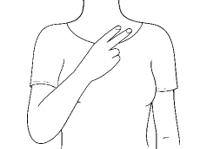
We start the SLD on the opposite side to the affected arm, so for left arm oedema, start on the right side of your collarbone.
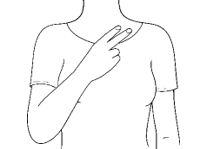
2 - Place a finger on either side of the collarbone towards your shoulder. The pressure applied should be enough to move the skin. It is a gentle and slow movement.
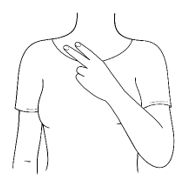
3 - Repeat these movements on the affected side – so now emptying the nodes on the left side of the collarbone.
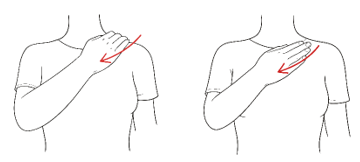
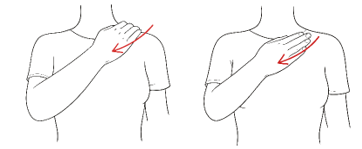
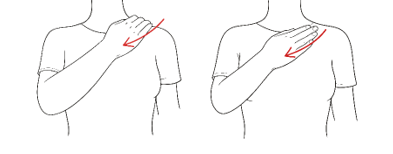
4 - Using your right hand, reach behind the left shoulder and slowly sweep and stretch the skin over the top of the shoulder towards the chest. Repeat this 4 times. This helps to drain any fluid from the back of the shoulder and towards the chest.
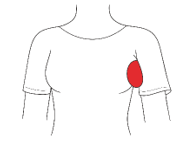
5 - Using either a soft ball (a rolled-up flannel or rolled up socks will also work) in the right axilla, gently squeeze and release the ball by raising your arm slowly up and down to drain any lymph nodes in that area. If this is difficult you can move your shoulder gently so performing a circular motion on the ball (or alternative item). Repeat this 4 times.
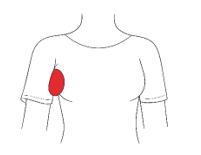
6 - Repeat the movements in the left axilla. If it is painful, do the movements as much as is comfortable.
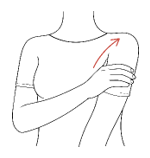
7 - Starting on the left upper arm, place your right hand around the arm just above the elbow. Push the skin gently and slowly towards the top of the shoulder, repeat this 4 times. Move your hand position slightly to cover the back of the arm also.
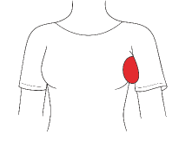
8 - Now repeat the ball squeezes in the left axilla 4 times as per step 6 to again empty the axilla.
9 - Repeat the shoulder sweeping movement as per step 4 to again drain the shoulder.
10 - Repeat the collarbone movements from step 2 and 3 to drain first the right and then left side of the collarbone.
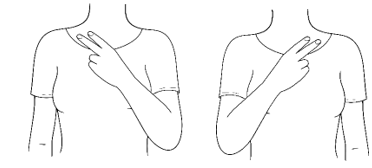
11 - To drain the lymph nodes in the elbow, place the soft ball (or alternative item) in the inner part of the left elbow. Gently and slowly squeeze and release the ball, repeating 4 times.
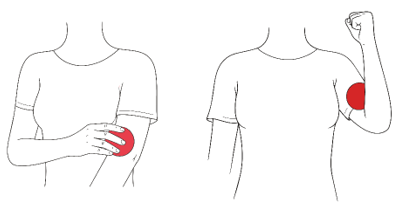
12 - Now to clear the lower arm, place your right hand just above the wrist. Push the skin gently and slowly towards the elbow, repeat this 4 times. Move your hand position slightly to cover the back of the forearm also.
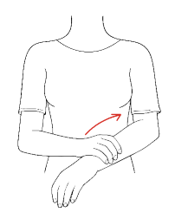
13 - Repeat the elbow movements as per step 11 to drain the elbow nodes.
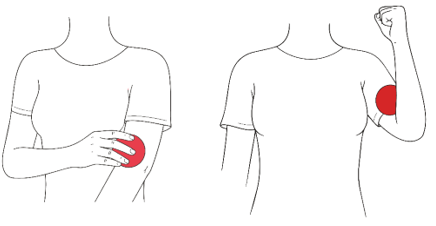
14 - Repeat the upper arm movements as per step 7.
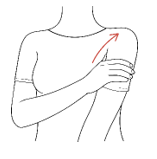
15 - Now repeat the ball squeezes in the left axilla 4 times as per step 6 to again empty the axilla nodes.
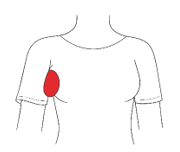
16 - Repeat the shoulder sweeping movement as per step 4 to again drain the shoulder.
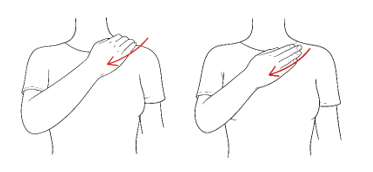
17 - Repeat the collarbone movements from step 3 to drain the left side of the collarbone.
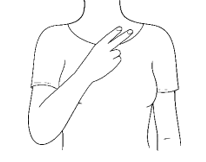
18 - Using your right hand, slowly sweep across the back of the left hand towards the wrist. Repeat this 4 times to drain the back of the hand.
19 - Hold the ball (or alternative item) in the palm of your left hand and squeeze and release the ball slowly 4 times.
20 - Using your right hand do a long slow sweep from the tips of your left fingers to the top of the left shoulder. Repeat 4 times, ensuring you cover the front and back of the arm.
21 - Now repeat the ball squeezes in the left axilla 4 times as per step 6 to again empty the axilla nodes.
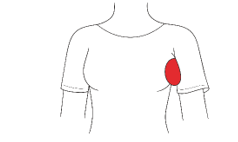
22 - Repeat the shoulder sweeping movement as per step 4 to drain the shoulder again.
23 - Repeat the collarbone movements from step 3 to drain the right side of the collarbone.
24 - Finish with some deep breaths. Starting with your fingers touching across the centre of your chest, as you take in a deep breath, stretch your arms out wide, stretching your fingers backwards also. As you exhale, bring your arms back in and hands meet in the centre of your chest. Repeat 4 times.
We are smoke-free
Smoking is not allowed anywhere on the hospital campus. For advice and support in quitting, contact your GP or the free NHS stop smoking helpline on 0800 169 0 169.
Other formats
Help accessing this information in other formats is available. To find out more about the services we provide, please visit our patient information help page (see link below) or telephone 01223 256998. www.cuh.nhs.uk/contact-us/accessible-information/
Contact us
Cambridge University Hospitals
NHS Foundation Trust
Hills Road, Cambridge
CB2 0QQ
Telephone +44 (0)1223 245151
https://www.cuh.nhs.uk/contact-us/contact-enquiries/