

Who is this leaflet for? What is its aim?
This leaflet is designed to give general advice to those who have experienced a central slip tendon injury, sometimes referred to as a “boutonniere deformity”, and to give advice with the aim of returning the finger to full movement and function.
What is a central slip injury?
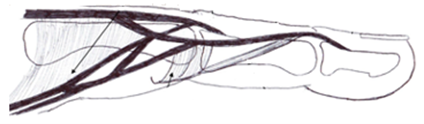
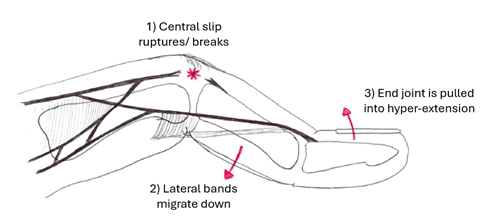
A central slip injury is when the tendon that straightens the middle joint of your finger is damaged. It can be caused by a cut over the middle joint of your finger or by an impact injury to the middle joint. Sometimes there is a small broken bone that is pulled away from the middle bone of the finger when the tendon is damaged. Depending on your type of injury, the period of splinting and rehabilitation may vary.
What are the symptoms?
You may be unable to straighten the middle joint of the finger. It may also be tender on the top of the joint. If left untreated then a tendon imbalance can occur. The middle joint can get stiff in a bent position. The joint above this is in an over-straight or hyper-extended position. This is known as a boutonniere (French for “button hole”) deformity.
Treatment
Splinting
To help the tendon heal, the middle joint must be immobilised and not allowed to bend for a period of time. If the tendon has been injured as the result of a cut, surgery may be required.
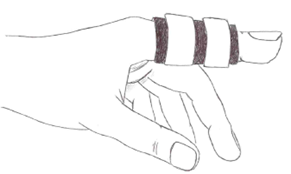
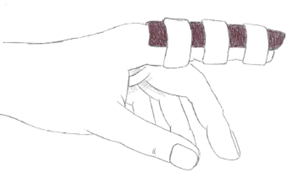
You will be given a custom-made splint that holds the middle joint straight - there are two examples below. It is important to move and exercise the unaffected joints above and below your injured joint, and your therapist will give you guidance on this. The exercises must be done with the splint in place, and it is very important you do not allow the middle joint to bend during this time.
The length of time you have to wear the splint depends on the type of injury. We recommend that you wear your splint full-time for …………weeks.
Exercises
Phase 1 exercises:
Below are the two exercises that can be started as soon as you are in your custom-made splint. Your therapist will provide details on how often to complete the exercises based on your levels of pain and stiffness.
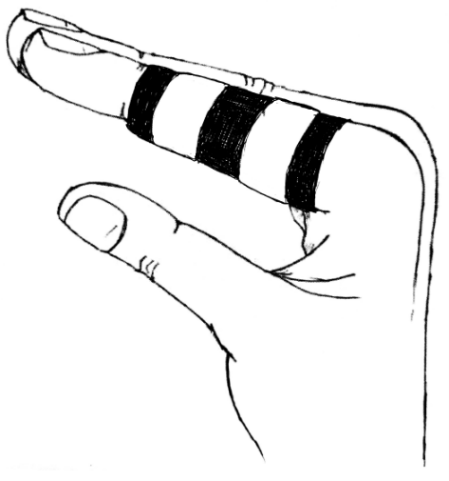
Start with your fingers straight, bend at the large knuckles keeping the top joints of your fingers as straight as you can. Hold for the count of 5, then straighten your fingers.
______repetitions
______times per day
______ seconds hold
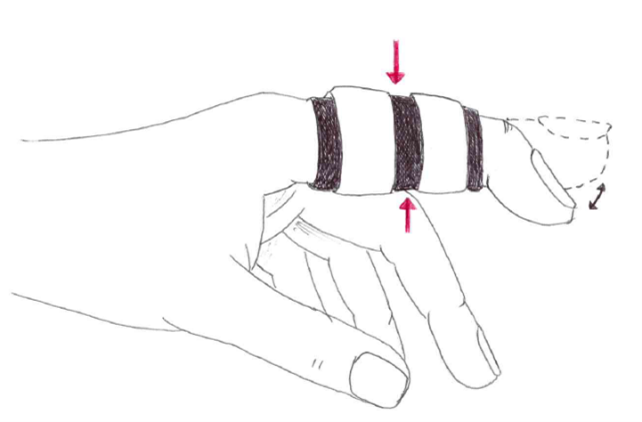
With your unaffected hand hold and stabilise the injured or stiff finger at the middle joint. This will prevent the middle joint from bending. Allow the movement to occur at the fingertip only. Bend and straighten the tip of the finger.
______repetitions
______times per day
______ seconds hold
Phase 2 exercises:
Depending on the type of injury, between three and six weeks after starting splinting you will be given an exercise splint which allows the middle joint to bend a small amount. Your hand therapist will increase the amount you are allowed to bed the joint every week for a further 3 weeks.
You continue to wear your initial protective splint in-between exercises.
An example of the graded exercise splint
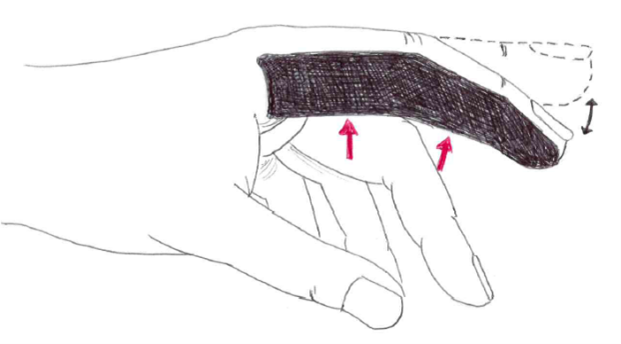
Place the injured finger onto the guide splint. Allow the middle joint to bend on to the guide splint then straighten. Repeat this movement.
______repetitions
______times per day
______ seconds hold
Recovery
It can take up to 12 weeks for your tendon to fully heal. You should avoid contact sports until then.
Returning to driving
You can drive when you feel you are safe to do so and have full control of the vehicle. This is entirely your own responsibility and we cannot give you permission to drive. Please refer to the DVLA website regarding fitness to drive, and liaise with your car insurance company.
Returning to work
Office work: return when you feel comfortable and work within pain limits.
Manual/heavy work requiring use of all fingers: no heavy use or tight gripping until you no longer need to wear the splint (at least six weeks after starting the guide board exercises).
Smoking cessation
Smoking increases fracture and tendon healing time. In extreme cases it can stop healing all together. Stopping smoking during the healing phase of your fracture will help to optimise your recovery.
For advice on smoking cessation and local support available please see the website: www.nhs.uk/live-well/quit-smoking/ or discuss this with your GP.
General advice
- Keep your hand elevated above your heart to help with swelling.
- Keep all joints that have not been splinted moving regularly, including other fingers, thumb, wrist, elbow and shoulder.
- Do not allow the splint to be exposed to heat as it may change its fit on your finger.
- Continue to use the hand for light activities, with the protective splint always in place, but avoid any heavy gripping or lifting until advised by your therapist.
Problems to look out for
- Your splint may become too big and doesn't stay in place meaning the middle joint is no longer protected.
- Your splint may be too tight and causes an increase of swelling or pain.
- Your skin may become sore in the splint.
- Any signs of infection (increased pain, redness, swelling and feeling generally unwell).
Who to contact in case of a problem
If you have any problems or questions regarding your hand therapy, please contact the hand therapy team on 01223 216769.
Your hand therapist is
…………………………………….
Contacts/Further information
The occupational therapy department is located in clinic 30 in the Addenbrooke’s Treatment Centre (ATC). The occupational therapy reception telephone number: 01223 216769
My Chart
We would encourage you to sign up for MyChart. This is the electronic patient portal at Cambridge University Hospitals that enables patients to securely access parts of their health record held within the hospital’s electronic patient record system (Epic). It is available via your home computer or mobile device.
More information is available on our website.
References/ Sources of evidence
- Capon et al (2019) Therapeutic management of closed central slip injuries: Outcome of a service evaluation, Hand Therapy, 24(1), p3-12.
- Evans, R. (2010) Early active short arc motion for the closed central slip injury, Journal of Hand Therapy, 23(4), p.e15-16.
- Kayalar et al (2009). The results of treatment for isolated zone 3 extensor tendon injuries. Acta Orthopaedica et Traumatologica Turcica, 43(4), pp.309–316.
- Kiefhaber, T. (1996) Closed tendon injuries in the hand, Operative techniques in sports medicine, 4(4), p227-241.
We are smoke-free
Smoking is not allowed anywhere on the hospital campus. For advice and support in quitting, contact your GP or the free NHS stop smoking helpline on 0800 169 0 169.
Other formats
Help accessing this information in other formats is available. To find out more about the services we provide, please visit our patient information help page (see link below) or telephone 01223 256998. www.cuh.nhs.uk/contact-us/accessible-information/
Contact us
Cambridge University Hospitals
NHS Foundation Trust
Hills Road, Cambridge
CB2 0QQ
Telephone +44 (0)1223 245151
https://www.cuh.nhs.uk/contact-us/contact-enquiries/