

What is a Clinical Psychologist?
Clinical Psychologists are health professionals trained to support people who may be experiencing difficulties with their emotional wellbeing.
A Clinical Psychologist works as part of the paediatric hearing implant team. The Clinical Psychologist that you and your child will meet with specialises in working with children with hearing loss and health problems. Part of their role is to help young people and parents make decisions regarding their health and offer support around surgical procedures. They are also there to support young people, children and parents who may be experiencing emotional and/or behavioural difficulties directly associated with their children’s hearing needs.
Meeting with a Clinical Psychologist
As part of your child’s assessment for a cochlear/hearing implant or for ongoing support following cochlear/hearing implants, you and your child may be offered the opportunity to meet with a Clinical Psychologist. This support is something that you can discuss with the health care professionals at the Emmeline Centre. Not all individuals will need to see a Psychologist, this is your choice.
What will happen in our appointment?
Your meeting with the Clinical Psychologist will usually take between 60 and 90 minutes.
The psychologist will ask lots of questions to learn about your child, their hearing and medical needs, development, and the social aspects of their life. Sometimes people can feel concerned when they asked if they want to see a psychologist and that they may be evaluated or judged. It is important for parents to know that the psychologist is not evaluating you, your child or your parenting. The psychologist is there to offer support and help families achieve positive outcomes.
How often will I meet with the Psychologist?
Most people attend for one or two sessions with the Psychologist during their assessment. Further sessions can be arranged following the assessment, depending on your/your child’s needs. Some people will see the Psychologist at the beginning of the hearing/cochlear implant assessment process while other families access support from the Psychologist further along their journey. Every young person and family is different and we are happy to offer support as needed.
What can a Clinical Psychologist help with?
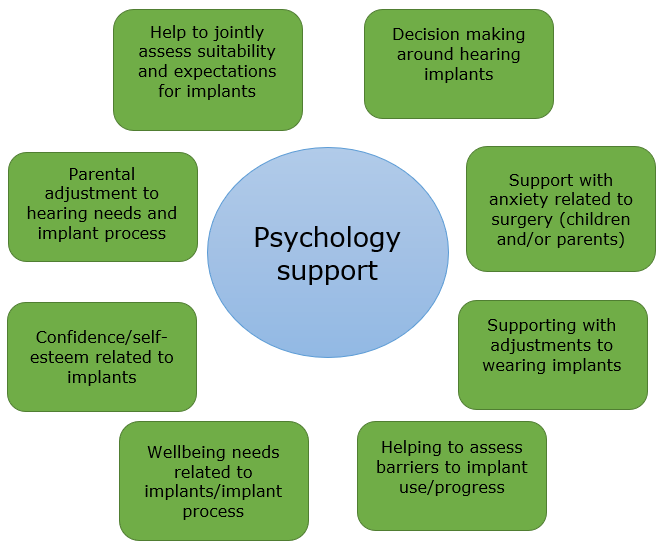
The Psychologist can help support you and your child in different areas related to the implant assessment process, or concerns following implant. Below are some examples of what a Psychologist at the Emmeline centre might help your family with.
How does my child get referred?
You can contact any member of the cochlear team you are in contact with. They will discuss this service and make a referral on your behalf. There may be occasions in which the team do not believe you would be suitable for this particular service, and they can talk to you about their decision and other options.
If you have any questions or concerns about seeing a Psychologist, or want to discuss the possibility of a referral directly please contact the Psychologist via:
Email address:
- cuh.emmeline@nhs.net (please state ‘for the attention of the Psychologist’ in the email)
Psychology reception number:
- 01223 217957 (please state you want to speak to the Psychologist in the hearing implant team and leave the best number and time to ring back on)
Please note, the Psychologist in the team works part-time and will not be able to speak to you immediately. If you have immediate/urgent concerns about you or your child, please contact your GP.
My Chart
We would encourage you to sign up for MyChart. This is the electronic patient portal at Cambridge University Hospitals that enables patients to securely access parts of their health record held within the hospital’s electronic patient record system (Epic). It is available via your home computer or mobile device.
More information is available on our website.
We are smoke-free
Smoking is not allowed anywhere on the hospital campus. For advice and support in quitting, contact your GP or the free NHS stop smoking helpline on 0800 169 0 169.
Other formats
Help accessing this information in other formats is available. To find out more about the services we provide, please visit our patient information help page (see link below) or telephone 01223 256998. www.cuh.nhs.uk/contact-us/accessible-information/
Contact us
Cambridge University Hospitals
NHS Foundation Trust
Hills Road, Cambridge
CB2 0QQ
Telephone +44 (0)1223 245151
https://www.cuh.nhs.uk/contact-us/contact-enquiries/