

This booklet contains information on:
- What is cortisol?
- Daily Management
- Sick day rule management
- Emergency hydrocortisone injections
- Emergency Department Management
- Medic Alerts and Red flagging
- Other Scenarios
- Schools
- Sources of further information
| Addenbrooke’s Hospital Contact Centre | (01223) 245151 |
|
Paediatric Endocrine Nurse Specialists (Monday – Friday 9am to 5pm) |
(01223) 217496 |
|
Paediatric Endocrine Registrar (Monday – Friday 9am to 5pm) |
Via Contact Centre |
|
Paediatric General Registrar (Out of Hours) |
Via Contact Centre |
|
Paediatric Endocrine Consultant (On call 24 hours) |
Via Contact Centre for hospital queries only |
Patient Name: …………………………..
Patient Date of Birth: ………………….
Hospital Number: ………………………
Cause of Adrenal Insufficiency: …………………………..
Date of Plan: …………………………….
What is cortisol?
The adrenal glands can be found above the kidneys and make a hormone called cortisol. Cortisol is the “stress hormone” and helps the body cope with illness, significant stress including accidents/fractures and when undergoing major operations.
Children and young people who are unable to make their own cortisol are diagnosed with adrenal insufficiency. This can be due to a variety of different reasons but all mean that the hormone needs replacing with a medicine called hydrocortisone.
This is a lifesaving treatment that MUST never be stopped suddenly or without medical consent.
This regular hydrocortisone treatment does not affect your child’s ability to participate in the same activities as their peers.
Daily Management
Hydrocortisone is taken three times a day. The first dose should be given upon waking in the morning and the other two spread as evenly as possible throughout the day. It is really important that doses are not missed. If your child or young person does miss a dose, please give this as soon as you remember and then continue to give any remaining daily doses as normal.
| Morning | Afternoon | Evening |
Sick-Day Rule Management
In the event of illness, the adrenal glands would naturally make more cortisol. For children and young people who need to take daily replacement hydrocortisone, it is really important that the extra the body needs to cope with illness is given as increased oral doses or in an emergency, as an injection.
If you are unsure whether to give more, it is better to err on the side of caution and give the extra steroids. If you do not your child or young person may become very unwell, and this could be life threatening. No harm will come in the short-term from giving extra hydrocortisone.
| How Unwell | Hydrocortisone Dose |
|---|---|
|
How Unwell
Mildly Unwell - Cold/cough without a temperature - Able to go to school |
Hydrocortisone Dose No change in daily hydrocortisone doses. |
|
How Unwell
Moderately Unwell - May keep off school - Temperature less than 39 degrees - May need antibiotics |
Hydrocortisone Dose Double the total daily dose of hydrocortisone and divide into four equal doses. Give a dose of hydrocortisone every six hours |
Moderately unwell Hydrocortisone dose
Give ____mg every 6 hours
| How Unwell | Hydrocortisone Dose |
|---|---|
|
How Unwell
Very Unwell - Off school - Temperature above 39 degrees - Needs antibiotics - Chicken pox |
Hydrocortisone Dose Triple the total daily dose of hydrocortisone and divide into four equal doses. Give a dose of hydrocortisone every six hours |
Very unwell Hydrocortisone dose
Give ____mg every six hours
Emergency Hydrocortisone Injection
Children and young people prescribed regular hydrocortisone will need an emergency hydrocortisone injection kit.
EMERGENCY INTRAMUSCULAR INJECTION
Please give an emergency injection of hydrocortisone if your child or young person:
- Is unable to take tablets or fluids by mouth (e.g. due to continued vomiting).
- Has severe diarrhoea.
- Feels sleepy, drowsy and is difficult to wake up.
- Does not feel better after increased tablets for two doses.
- Has been involved in a major accident.
Emergency Hydrocortisone Doses
- Age < 1 year: 25 mg
- Age 1 to 5 years: 50 mg
- Age > 6 years old: 100 mg
Instructions for Solu-cortef (Hydrocortisone sodium succinate) vials
IN CASE OF EMERGENCY
- PHONE 999 AND ASK FOR A PARAMEDIC AMBULANCE.
- TELL THE OPERATOR THAT YOUR CHILD IS TAKING STEROID TREATMENT AND THAT THEY ARE AT RISK OF ADRENAL CRISIS.
- TELL THEM THAT YOUR CHILD WILL NEED AN INJECTION OF HYDROCORTISONE AND YOU HAVE THIS MEDICATION AT HOME.
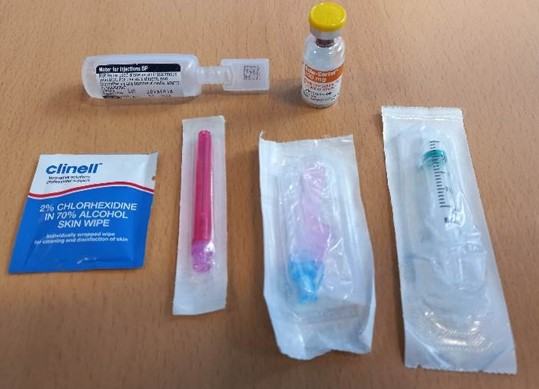
Equipment Needed
- Clinell wipe
- 2ml syringe
- Blue needle
- Red filter needle
- Hydrocortisone vial
- Water for Injection ampoule
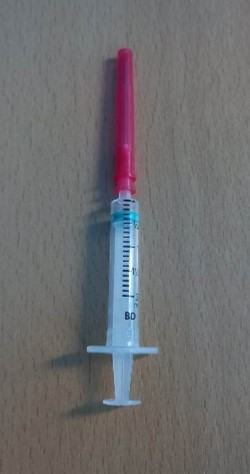
- Remove the syringe from the sterile packet without touching the nozzle of the syringe.
- Carefully remove the red ‘fill’ needle from the sterile packet and attach it to the nozzle end of the syringe.
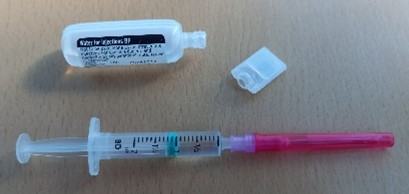
Place the water for injection on a flat surface and draw up 1ml using the syringe and needle.
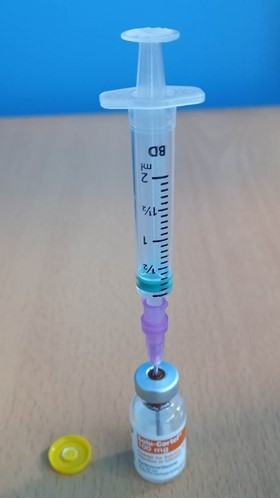
- Remove the cap and insert the needle into the bung of the Solu-Cortef 100 mg vial. Push the water in to produce 100mg/ml solution.
- Leave the needle and syringe in the vial whilst waiting for the powder to dissolve. Do not shake the vial.
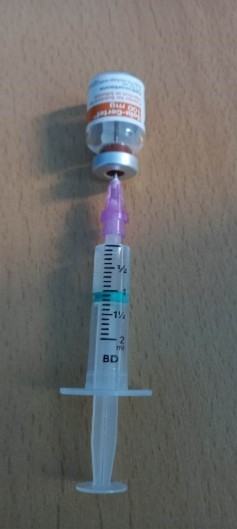
- Once dissolved, carefully draw up the contents of the vial into the syringe.
- Remove the needle from the vial.
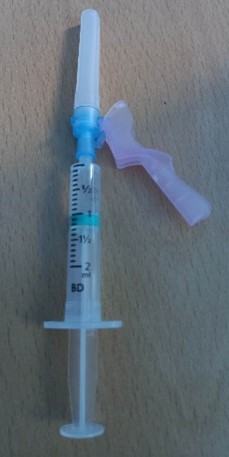
- Remove the red ‘fill’ needle from the syringe and attach a new blue (or orange) ‘giving’ needle.
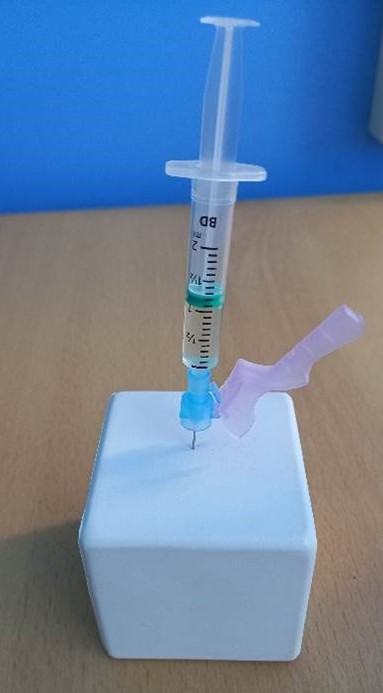
- Turn the syringe so that the needle is pointing upwards.
- Tap the syringe to ensure any air bubbles rise to the top.
- Gently push up the plunger so that any air is expelled from the syringe.
- Gently push up the plunger to expel any excess hydrocortisone so that you have the correct dose for the child.
- Your child should be lying down in a safe position.
- The injection should be given into the upper outer thigh or the upper outer aspect of the bottom depending on where you have been shown to give it.
- Clean the skin with the small alcohol wipe.
- Place one hand on the surrounding skin.
- Smoothly insert the needle through the skin to a depth of about half the length of the needle.
- Smoothly push down the plunger until the syringe is empty.
- Remove the needle and syringe from the skin and dispose of the needle in a sharps bin if you have one. (If a sharps bin is not available, put the needle in an empty sandwich box or other suitable container and take it with you to hospital where it can be disposed of safely.)
- Take your child to your nearest hospital with an Emergency Department immediately.
Instructions for Emergency Hospital Management
If the patient is brought to hospital as an emergency, please take the prompt action as below:
- Ask if IM hydrocortisone has been given and if it has not been, please give ASAP.
- Check blood glucose (give 2ml/kg 10% dextrose bolus if glucose <2.6 mmol/L).
- Take blood for electrolytes (U&Es) and other appropriate tests, e.g. blood culture.
- If circulation is compromised, give bolus of 10ml/kg of 0.9% saline. Repeat if necessary.
- Start IV infusion of 0.9% saline 5% dextrose at maintenance rates (extra if dehydrated).
- Continue IV hydrocortisone every 6 hours as follows:
Age < 1 year: 25mg
Age 1 to 5 years: 50mg
Age > 6 years old: 100mg
Please admit for at least 12 hours and inform the Paediatric Endocrine Team at Addenbrooke’s Hospital.
- If the patient tolerates oral fluids, swap IV hydrocortisone to TRIPLE or DOUBLE dose oral Hydrocortisone (give as 4doses/day).
- Review the patient before discharge from the hospital.
- Once patient is better, advise them to reduce hydrocortisone to usual dose after 2 days unless on antibiotics. If on antibiotics, continue on double dose for duration of treatment.
- If the patient also takes DDAVP (desmopressin), keep careful fluid balance, monitor electrolytes and consider dose alteration. Seek specialist advice.
- If the patient takes fludrocortisone, please continue at their usual dose.
My Cortisol app

Great Ormond Street Hospital has developed a free training app for giving an emergency injection of hydrocortisone. The app is a real time video showing the technique. There is no audio with the video making it accessible to all users regardless of language or if it is being used in a noisy environment. There is a tab with the still version of the procedure on it, a tab for parents to input doses, contact numbers and finally a tab with care instructions for a receiving A&E doctor. The My Cortisol app is available for both Apple and Android devices.
Medic Alerts
It is important that your child or young person wears a medical alert stating that they are taking steroids and are at risk of having an “Adrenal Crisis. This will help medical teams treat your child or young person more quickly and more efficiently if they suddenly become suddenly unwell. There are several different medic alert options which can be ordered online.
Summery Care Records
Your child or young person’s adrenal insufficiency can be added to their Summery Care Record from their GP surgery’s notes. This record can be accessed by other health care professionals such as paramedics and ambulance crews. It provides additional medical information to help treat your child or young person should they become unwell.
Other scenarios
Dental
No extra hydrocortisone is needed for a routine dental appointment.
General Anaesthetic and Surgery
Prior to any planned surgery or general anaesthetics, your child or young person should continue to take their regular hydrocortisone as normal, including on the day of surgery.
You should let the anaesthetist know that your child is taking hydrocortisone so they can give extra during surgery.
Immunisations
Your child or young person can have all their childhood or other immunisations as normal. It can be helpful to give them a double dose of hydrocortisone for 24 hours after the immunisation is given.
Other medication
Your child or young person can take other medication alongside their hydrocortisone e.g. paracetamol, ibuprofen, antibiotics. If they are prescribed another steroid, then please let the Endocrine team know so we can check your child or young person’s doses.
School
Your child’s or young person’s school should have:
- A copy of their school care plan (we can provide this).
- Spare hydrocortisone medication.
- An emergency injection pack on site. (We do not expect schools to give the emergency injection but it can be there for paramedics and ambulance crews to access should it be needed).
If your child or young person’s school has any questions or queries about their condition or medication, we are happy to speak to them over the phone.
Sources of further information
Contact details
You can contact the Paediatric Endocrine Nurses any advice about your medication, school or general questions on 01223 217496.
For questions about appointment bookings, please call the Weston Centre reception on 01223 348576.
We are smoke-free
Smoking is not allowed anywhere on the hospital campus. For advice and support in quitting, contact your GP or the free NHS stop smoking helpline on 0800 169 0 169.
Other formats
Help accessing this information in other formats is available. To find out more about the services we provide, please visit our patient information help page (see link below) or telephone 01223 256998. www.cuh.nhs.uk/contact-us/accessible-information/
Contact us
Cambridge University Hospitals
NHS Foundation Trust
Hills Road, Cambridge
CB2 0QQ
Telephone +44 (0)1223 245151
https://www.cuh.nhs.uk/contact-us/contact-enquiries/