Introduction
Hypoglycaemia, low blood glucose levels, has been recognised recently as a complication of some types of Bariatric surgery. It is given the name post-bariatric hypoglycaemia and is sometimes referred to as late dumping as it usually occurs 2-4 hours after eating. Usually, the onset of post-bariatric hypoglycaemia occurs at least a year after surgery.
This leaflet will help you to understand more about this phenomenon and how we can help you to reduce episodes of low blood glucose levels.
What are the symptoms of low blood glucose levels?
The symptoms of hypoglycaemia usually begin when your blood glucose levels fall to somewhere between 3.0mmol/l and 4.0mmol/L. Symptoms can vary from person to person, but it is important to be aware of them. Some of the signs and symptoms of hypoglycaemia can include:
- Fatigue
- Dizziness
- Light-headedness
- Going pale
- Sweating
- Palpitations
- Nervousness
- Irritability
- Anxiety
- Trembling or shakiness
- Rapid heartbeat
- Blurred vision
- Difficulty concentrating
- Confusion
- Disorderly or irrational behaviour (often mistaken for drunkenness)
- Flushing
- Tingling lips
- Increased appetite
- Nausea
- Vomiting
However, these symptoms are non-specific and may be due to other causes.
Why does bariatric surgery cause hypoglycaemia?
Several years after this phenomenon was first described it is still poorly understood.
It is, however, thought that low blood glucose levels are related to changes, in both insulin and other hormones produced by the gastrointestinal tract, triggered by high carbohydrate content at a mealtime or after eating refined carbohydrates (carbohydrates that are quickly broken down into sugars).
The hypoglycaemia usually occurs approximately 2-4 hours after eating.
What should you do if you experience these symptoms?
Having a low blood glucose level is not good for your overall health and can be life threatening. If you are experiencing symptoms suggestive of low blood glucose levels, we usually ask your GP to issue you with a blood glucose meter which you should use to test your blood glucose level when the symptoms occur. This meter is a portable device used to measure blood sugar levels, usually obtained from a finger prick.
If the blood glucose level is above 4mmol/l, it is less likely that the symptoms you have been experiencing are due to hypoglycaemia.
If your blood glucose level is less than 3.5mmol/l, you will need to relieve your symptoms immediately.
We advise that patients who have been diagnosed with post-bariatric hypoglycaemia should always carry a fast-acting carbohydrate to treat hypoglycaemia and carry a blood glucose meter.
Please see the diagram below for advice on the treatment of emergent hypoglycaemia.
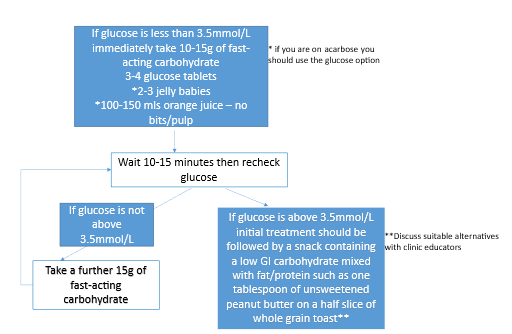
If glucose is less than 3.5mmol/L immediately take 10-15g fast-acting carbohydrate 3-4 glucose tablets *2-3 jelly babies *100-150mls orange juice - no bits/pulp *if you are on acarbose you should use the glucose option.
Wait 10-15 minutes then recheck glucose.
If glucose is not above 3.5mmol/L, take a further 15g of fast-acting carbohydrate and recheck glucose after 10-15 minutes.
If glucose is above 3.5mmol/L initial treatment should be followed by a snack containing a low GI carbohydrate mixed with fat/protein such as one tablespoon of unsweetened peanut butter on half a slice of whole grain toast **discuss suitable alternatives with clinic educators.
It is important to note that following treatment of a low blood glucose level with fast-acting carbohydrate, there is a possibility of another episode of hypoglycaemia known as rebound hypoglycaemia. Therefore following the initial treatment with a fast-acting carbohydrate, this should be followed by a snack containing a low GI carbohydrate and you should monitor blood glucose levels closely for the next four hours.
At blood glucose levels of 3.5-4mmol/L a 10-15g carbohydrate snack (e.g. a banana or 2x oat biscuits) should be taken.
How can hypoglycaemia be prevented?
Hypoglycaemia following bariatric surgery may respond well to dietary adjustments.
The initial advice is usually to recommend dietary changes. The advice will usually suggest reducing the amount of refined carbohydrates and choosing carbohydrates of a lower glycaemic index.
- Eat small, regular meals lower in carbohydrate.
- Space meals and snacks 3-4 hours apart.
- Choose low glycaemic (GI) index foods.
- Avoid or limit foods high in sugar.
- Avoid or limit alcohol and caffeine.
- Add soluble fibre to foods.
- Avoid liquids with meals and for 30 minutes before and after meals.
- Make sure you are taking your recommended vitamins and minerals.
What foods contain carbohydrate?
| Foods containing flour | Foods containing starch | Foods containing sugar | Other examples |
|---|---|---|---|
| Foods containing flour Bread | Foods containing starch Breakfast cereals | Foods containing sugar Cakes and biscuits | Other examples Fruit |
| Foods containing flour Crackers and crisp breads | Foods containing starch Potato | Foods containing sugar Ice cream | Other examples Fruit juice and smoothies |
| Foods containing flour Pies and pastries | Foods containing starch Rice | Foods containing sugar Sweets, chocolate and mints | Other examples Yoghurt and fromage frais |
| Foods containing flour Breaded and battered foods | Foods containing starch Pasta | Foods containing sugar Fizzy drinks and squashes | Other examples Milk |
| Foods containing flour Biscuits and cakes | Foods containing starch Noodles | Foods containing sugar Syrup and treacle | Other examples |
| Foods containing flour Dumplings | Foods containing starch Couscous | Foods containing sugar Jam, marmalade and lemon curd | Other examples |
| Foods containing flour Yorkshire puddings | Foods containing starch | Foods containing sugar Honey and chocolate spread | Other examples |
Carbohydrate provides us with an essential source of energy for our body. We digest carbohydrate as glucose into our blood. Any foods that contain carbohydrate will cause your blood glucose level to rise. Insulin helps transport the glucose from the blood into the muscles and tissues where it is stored or used for energy.
What type of carbohydrate should you be eating?
The type of carbohydrate you eat, as well as the amount, is important.
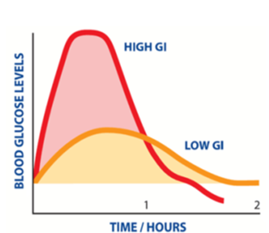
Carbohydrates are digested and absorbed at different rates. The term to describe this is Glycaemic Index (GI); it is a way of measuring the effect individual carbohydrate foods have on blood glucose levels. It recognises that not all carbohydrates affect blood glucose in the same way.
The GI value of a food is tested on the food when it is eaten on its own. Glucose is used as the standard reference (GI 100) and other foods are measured against this.
What may affect the GI of a food?
There are many factors that can affect the GI of a food, for example:
- Cooking methods (frying, boiling, baking) may increase GI.
- Processing foods can increase GI.
- The riper a fruit or certain vegetable the higher the GI.
- Whole-grains and high fibre foods act as a physical barrier to slow down digestion of carbohydrate. This is not the same as ‘wholemeal’ where, even though the whole of the grain is included, it has been ground instead of left whole. So many mixed-grain breads that include whole-grains have a lower GI than either wholemeal or white bread.
- Fat can lower the GI of food.
- Protein lowers the GI of food.
- Milk and other dairy products have a low GI because of their high protein content, and because they contain fat.
How will you benefit from low GI foods?
Choosing low GI foods as part of a balanced lifestyle can help to minimise fluctuations in blood glucose levels. Including more foods with low GI in meals can reduce post-meal peaks in blood glucose levels and help keep blood glucose more even over the day.
Low GI foods can give a feeling of fullness for longer. High GI means that food eaten in large quantities will cause a greater rise in blood glucose levels, and more of an insulin response, than low GI foods eaten in the same quantity. Therefore, it is preferable to eat low GI foods, but if high GI goods are eaten, it is suggested to limit portion sizes. Some examples of carbohydrates that have a lower glycaemic index include whole grain oats, wholegrain wheat, corn bran and oatmeal.
Food and Symptom Diary
It is a good idea to keep a food and symptom diary to help identify patterns and relationships between foods eaten and symptoms experienced. If you have been issued with a blood glucose monitor, we recommend that you test your blood glucose levels if you are experiencing symptoms. This may confirm whether you are hypoglycaemic when symptomatic. We will encourage you to document your blood glucose level and at your next appointment we can review your food intake, symptoms and blood glucose levels.
An example of a food and symptom diary is shown below.
| Date | Symptoms | Blood Glucose Level | Food eaten in preceeding 2-6h |
|---|---|---|---|
| Date | Symptoms | Blood Glucose Level | Food eaten in preceeding 2-6h |
| Date | Symptoms | Blood Glucose Level | Food eaten in preceeding 2-6h |
| Date | Symptoms | Blood Glucose Level | Food eaten in preceeding 2-6h |
| Date | Symptoms | Blood Glucose Level | Food eaten in preceeding 2-6h |
| Date | Symptoms | Blood Glucose Level | Food eaten in preceeding 2-6h |
| Date | Symptoms | Blood Glucose Level | Food eaten in preceeding 2-6h |
| Date | Symptoms | Blood Glucose Level | Food eaten in preceeding 2-6h |
| Date | Symptoms | Blood Glucose Level | Food eaten in preceeding 2-6h |
| Date | Symptoms | Blood Glucose Level | Food eaten in preceeding 2-6h |
| Date | Symptoms | Blood Glucose Level | Food eaten in preceeding 2-6h |
What about medical treatments?
There are some medications that have been used with some success to help manage hypoglycaemia following bariatric surgery.
If we feel that it is appropriate to start you on a medication to help manage your hypoglycaemia, we will discuss this with you at your clinic appointment.
It may be that we request your GP to prescribe a medication called Acarbose if dietary changes have not helped to manage your hypoglycaemia. This is a medication that delays the digestion and absorption of carbohydrates, which therefore helps to reduce the risk of having lower blood glucose levels. This medication is usually taken with meals. Tablets should be chewed with the first mouthful of your food or swallowed whole with liquid immediately before food. In the first two or three days of taking Acarbose it is common to have flatulence, feel a rumbling in your stomach, feel full or experience cramps in the stomach. Some people also have diarrhoea and pain in the stomach. Contact the team if these side effects persist beyond two or three days.
Driving for people diagnosed with hypoglycaemia
Post bariatric hypoglycaemia negatively impacts driving performance. If you are diagnosed with post-bariatric hypoglycaemia (PBH) you should contact the DVLA for advice.
You should check glucose levels just before you start driving (each journey) and continue to check at least every 2 hours during your journey ensuring that no more than 2 hours has passed between glucose checks at any time during your journey. You must pull over safely before testing or checking your device.
If you are a group 2 driver (bus and lorry) please contact the DVLA for further advice regarding hypoglycaemia and requirements for licencing.
If you have had an episode of severe hypoglycaemia (defined as hypoglycaemia requiring the assistance of another person) or if you have impaired awareness of hypoglycaemia (when you do not experience the usual warning signs to detect the onset of hypoglycaemia such as sweats and tremors), you must stop driving and contact the DVLA.
What if hypoglycaemia is not associated with food intake?
If episodes of hypoglycaemia occur when you are in a fasting state, this needs to be investigated further and you may be brought into hospital for medical investigations. A fasting state is, for example, first thing in the morning on waking up before you have eaten breakfast.
Contacts/Further information
If you have any further questions or wish to talk to a member of the Obesity Clinical Team about any aspect of your treatment, please do not hesitate to ask during your next clinic appointment or contact the Obesity Team by the following means:
By telephone: 01223 348 124 (answer machine).
Please leave a message with your Name, Hospital number (MRN) and date of birth and we will return your call as soon as possible.
By My Chart: We would encourage you to sign up for MyChart. This is the electronic patient portal at Cambridge University Hospitals that enables patients to securely access parts of their health record held within the hospital’s electronic patient record system (Epic). It is available via your home computer or mobile device.
More information is available on our website.
References/ Sources of evidence
Hazlehurst J, Khoo B, Lobato CB, Ilesanmi I, Abbott S, Chan T, Pillai S, Maslin K, Purkayastha S, McGowan B, Andrews R, Tan TM.Endocr Connect. 2024 May 1;13(5):e230285. doi: 10.1530/EC-23-0285. Epub 2024 Apr 1.
We are smoke-free
Smoking is not allowed anywhere on the hospital campus. For advice and support in quitting, contact your GP or the free NHS stop smoking helpline on 0800 169 0 169.
Other formats
Help accessing this information in other formats is available. To find out more about the services we provide, please visit our patient information help page (see link below) or telephone 01223 256998. www.cuh.nhs.uk/contact-us/accessible-information/
Contact us
Cambridge University Hospitals
NHS Foundation Trust
Hills Road, Cambridge
CB2 0QQ
Telephone +44 (0)1223 245151
https://www.cuh.nhs.uk/contact-us/contact-enquiries/