

Introduction
You have been prescribed a blood-thinning injection for you (or a family member) to continue to administer at home. This leaflet explains why the injection is needed and provides clear, step-by-step guidance on how to give it safely.
Blood-thinning injections are commonly prescribed to reduce the risk of blood clots in people who are less mobile or who have certain medical or surgical conditions.
Most people find the injection straightforward after practice. However, if you do not feel confident, please speak to your doctor or nurse before leaving hospital, as support from Community Nursing Services can be arranged.
It is important that you do not miss any doses unless advised by your healthcare team.
What you need to know
Purpose
Low Molecular Weight Heparin (LMWH) is an anticoagulant (blood-thinning) medication used to help prevent or treat blood clots. It reduces the blood’s ability to clot, lowering the risk of conditions such as deep vein thrombosis (DVT) and pulmonary embolism (PE).
It is commonly used for patients recovering from surgery (including orthopaedic procedures like hip or knee replacements), as well as in other situations where the risk of clotting is higher, such as reduced mobility, prolonged bed rest, certain cancers, or pregnancy.
There are different types of blood-thinning injections. Commonly used examples are enoxaparin, tinzaparin, dalteparin, or fondaparinux, but your treatment will be individual to you. In most cases, the full course of injections will be provided to you on discharge from hospital. If you need to use a blood-thinning injection for a longer period, then ongoing supplies will come from your GP or a hospital clinic setting.
How to administer the injection
The device comes as a pre-filled syringe intended for injection under the skin. The injection is to be given into a fatty area of the body. The recommended injection sites are abdomen, thighs or upper arms. The correct injection sites are highlighted in the picture below.
Injection sites in detail
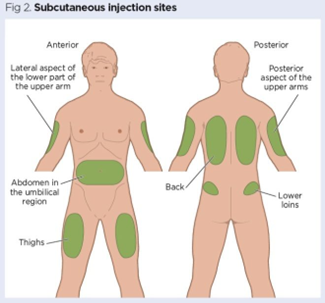
Upper Arm: Find the area halfway between the elbow and shoulder. You should be able to grasp 1 to 2 inches (5 cm) of a fatty fold of skin. This site is generally suitable when another person will be administering the injection.
Abdomen: Find the area below the waist to just above the hip bone and from the side to about 2 inches (5 cm) away from the belly button. Avoid the belly button itself.
Thigh: Find the area halfway between the knee and hip and slightly to the side. You should be able to grasp 1 to 2 inches (5 cm) of a fatty fold of skin.
Dose and Frequency
Blood-thinning injections may be prescribed in different doses and schedules, depending on:
- Your medical or surgical condition
- Your weight
- Kidney function
- Other medical conditions
- Your individual risk of clotting or bleeding
Some patients may need an injection once daily, while others may require a different dose or frequency.
Your prescriber and healthcare team, will tell you:
- How much to inject
- How often to inject it
- How long you need to continue treatment
⚠️ Always follow the instructions given specifically to you.
Preparation
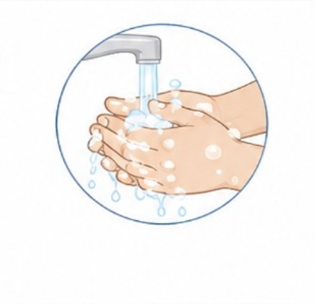
- Wash your hands and clean the injection site with soap and water. Alternatively, on socially clean skin, use an alcohol swab on the injection site. Allow the injection site to dry before administration.
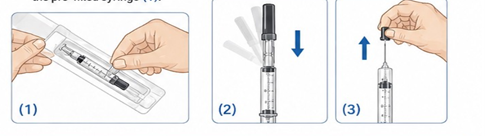
2. Remove the plastic blister containing the pre-filled syringe from the box. Open the blister and remove the pre-filled syringe (1).
3. Some products may have a needle trap as well as a needle cap. Move the needle-trap down if it has one (2). Carefully remove the needle cap by pulling it (3). Do not attempt to remove any air bubbles before injecting, as this is there intentionally and can lead to loss of medicine.
Injection
4. Pinch a fatty fold of skin between your fingers, this will be the injection site (4).
5. With the other hand hold the syringe and firmly insert the needle in full at a 45- or 90-degree angle into the skin fold (5). Push the plunger to inject the medicine, wait a few seconds, then pull the needle out.
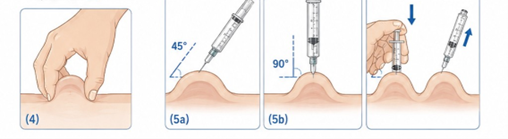
6. Initially this may feel a little uncomfortable and painful, but future injections should feel less so. To avoid bruising, do not rub the injection site after you have injected yourself.
Disposal
7. Do not attempt to re-apply the cap to the needle as this can cause needle stick injury (6).
8. Some anticoagulant injections come with their own needle-trap systems (7):
- If you were given Inhixa (enoxaparin) injections: Push hard the plunger. The needle guard, which is in the form of a plastic cylinder, will be activated automatically and it will completely cover the needle.
- If you were given Fragmin (dalteparin) or Innohep (tinzaparin) injections: Place the plastic catcher against a hard, stable surface and with one hand pivot the syringe barrel upwards against the needle forcing the needle into the catcher where it locks in place. Continue bending the needle until the syringe exceeds a 45-degree angle with the flat surface to render it permanently unusable.
- If you were given Arixtra (fondaparinux) injections: When you release the plunger the needle will automatically withdraw from the skin and go back into the security sleeve where it will be locked permanently.
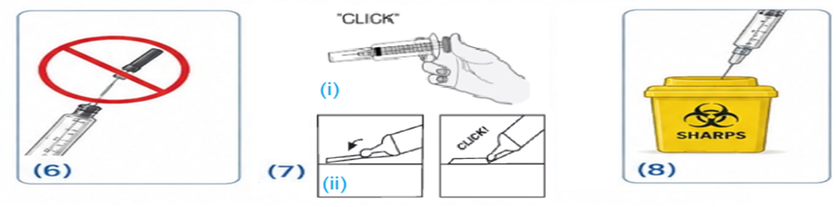
9. After ensuring the needle is protected, dispose of the syringe in the yellow sharps bin provided (8).
Facts about low molecular weight heparin or fondaparinux injection
- This medicine increases your risk of bleeding. Take care when shaving or using sharp objects.
- If you have heavy bleeding from a surgical wound or from your nose, mouth or rectum you must inform your doctor immediately.
- It is common to develop bruises around the injection site. Bruises will fade away in 1-2 weeks' time.
- If you forget whether you had your injection today, seek advice from your doctor.
- The small air bubble inside the syringe is meant to be there, do not remove it as this may lead to loss of medicine.
- The injection site can be painful for a few minutes after injection. Do not rub the area.
Bleeding
Call 999 or go to A&E now if you are experiencing severe bleeding that you cannot stop, vomiting blood, coughing blood, experiencing sudden severe headache, sudden weakness/numbness, chest pain or shortness of breath, or if you have had a significant head injury/fall, as blood-thinning medication can increase the risk of internal bleeding.
Call your GP / NHS 111 urgently if you experience blood in urine, black/tarry stools, unexpected large bruises, prolonged nosebleeds, heavy periods, increasing wound bleeding.
Rotating Injection Sites
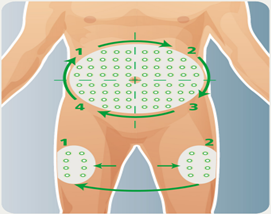
You should change the injection site each day. The diagram below shows how to rotate the sites to avoid using the same area repeatedly. The same rotation method can also be used for the upper thighs or upper arms, if advised by your clinician.
Rotating the injection site helps reduce the risk of complications such as bruising, skin irritation, scarring, or small lumps under the skin. Avoid injecting around existing scars or bruises.
Scan the QR code below to watch a video on how to administer Inhixa (enoxaparin) (opens in a new tab) subcutaneous injections by Techdow Pharma (v3 2026).

This alternative video demonstrates the injection technique in administering low molecular weight heparin (LMWH) of fondaparinux . Scan the QR code below to watch. YouTube video: “How To Give A Blood Thinner (Anticoagulant) Shot (opens in a new tab)” by Nucleus Medical Media 1 March 2022.

Disposing of Full Sharps Bins
You should have been provided with a sharps bin before leaving the hospital. Do not place used needles or any other sharps in your household waste or general rubbish bins. Once your sharps bin is full, it must be disposed of safely. Your local Council is responsible for collecting full sharps bins. Please contact your local Council to arrange collection or to receive information on their disposal service. Alternatively, take used sharps bins to a pharmacy that accepts self-medicating patients’ returns.
MyChart
We would encourage you to sign up for MyChart. This is the electronic patient portal at Cambridge University Hospitals that enables patients to securely access parts of their health record held within the hospital’s electronic patient record system (Epic). It is available via your home computer or mobile device.
More information is available on our website.
Contacts / Further information / questions
If you have any questions or concerns about your blood-thinning injection, please speak to:
- Your ward nurse
- Your GP
- Community nursing services
References / Sources of evidence
- Enoxaparin (Inhixa) Patient Information Leaflet
- Dalteparin (Fragmin) Patient Information Leaflet
- Tinzaparin (Innohep) Patient Information Leaflet
- Fondaparinux (Arixtra) Patient Information Leaflet
Privacy & dignity
Same sex bays and bathrooms are offered in all wards except critical care and theatre recovery areas where the use of high-tech equipment and/or specialist one to one care is required.
We are smoke-free
Smoking is not allowed anywhere on the hospital campus. For advice and support in quitting, contact your GP or the free NHS stop smoking helpline on 0800 169 0 169.
Other formats
Help accessing this information in other formats is available. To find out more about the services we provide, please visit our patient information help page (see link below) or telephone 01223 256998. www.cuh.nhs.uk/contact-us/accessible-information/
Contact us
Cambridge University Hospitals
NHS Foundation Trust
Hills Road, Cambridge
CB2 0QQ
Telephone +44 (0)1223 245151
https://www.cuh.nhs.uk/contact-us/contact-enquiries/