Who is this information for?
This information is for young people with Inflammatory Bowel Disease (IBD) and their parents/guardians. When you are diagnosed with IBD it is common to lose weight and have a poor appetite but when you are well (in remission) it is important to eat a balanced, healthy diet to ensure you are meeting your requirements for normal growth and development and to prevent any vitamin or mineral deficiencies.
Growth and development
At each of your clinic appointments you will have your height and weight measured, and plotted on a growth chart, to make sure that you are growing appropriately and that you are not under or overweight. Your doctor or nurse will let you know if there is concern about your growth. You can help by eating a well-balanced diet that will meet all of your nutritional requirements.
The balanced diet (Eat Well Guide)
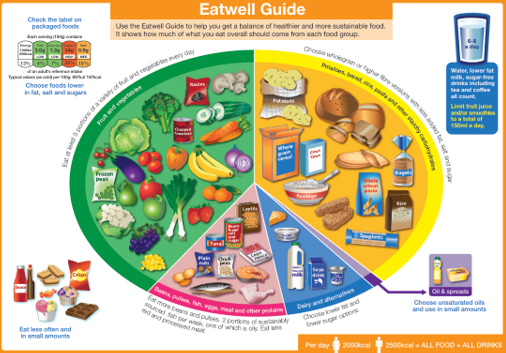
It is recommended that you eat foods from the five different food groups illustrated in the proportions shown on the Eat Well Guide.
Ways to make sure your diet is well-balanced
| Fruit and vegetables |
• Aim for five portions per day. One portion is equal to what fits into the palm of your hand • You can have fresh, tinned, dried or frozen fruit and vegetables • Limit fruit juice to one 150ml glass of fruit juice • One serving of baked beans counts towards your 5 a day! • Fruit and vegetables should make up a third of your plate |
| Potatoes, bread, rice, pasta and other starchy carbohydrates |
• Choose low sugar cereals, for example Weetabix, Bran Flakes, Shredded Wheat, Shreddies, Rice Krispies, Cornflakes, porridge and Muesli • Choose baked or mashed potatoes rather than chips or roast potatoes • Wholemeal / 50:50 products can increase fibre content and keep you fuller for longer • Carbohydrates should make up a third of the plate |
| Beans, pulses, fish,eggs and other proteins |
• Protein foods include meat, fish, dairy products, tofu and beans/lentils • Try to include a portion with each meal • A portion of protein should fit in the palm of your hand |
| Snacks |
• Try to choose snacks that include at least 2 of the main food groups • This may be veg sticks + dairy based dip / breadsticks + houmous / fruit + nut butter • Portion snacks onto a plate rather than eating out of a larger container to notice quantity eaten • Cakes, biscuits and crisps should be eaten less often |
| Oils and spreads (fat) |
• Choose lower-fat foods where possible, for example semi-skimmed milk, low fat yogurts, low fat spread • Avoid fried or fatty foods; they can be grilled, oven baked or air-fried instead • Choose unsaturated fats, such as sunflower and olive-based oils and spreads rather than animal-based fats |
| Drinks |
• Aim for six to eight drinks per day around meal and snack times. More may be needed in very hot weather or if you are very active • Suitable drinks include water, milk and well diluted fruit juices • Avoid sugary/fizzy drinks if possible as they contain few nutrients and are bad for the teeth |
Vitamins and minerals
Vitamins and minerals are needed for growth and repair within your body. All of your requirements for these can be met by eating a wide range of foods including lots of different fruits and vegetables. If this is difficult you can buy an over-the-counter multivitamin and mineral supplement. There is a range of formulations available including liquids, tablets, chewable chews. There are some vitamins and minerals that having IBD makes you more at risk of having low levels so it is worth checking to ensure you have good sources within your diet.
Calcium
Calcium is an important mineral and is a major component of bones and teeth. It is especially important that young people with IBD eat enough calcium as they are at increased risk of poor bone development. This can be due to some medications preventing absorption of all the calcium from the diet.
Good sources of calcium are dairy products (milk, cheese, yogurts) and fortified non-dairy alternatives (soya, oat, coconut milk, rice milk). You should aim for two to three portions per day. A portion is a glass of milk, 30g of cheese or a 120g pot of yoghurt.
There is more detailed information on calcium available – your IBD nurse or dietitian will be able to provide written resources.
Vitamin D
Vitamin D is a fat-soluble vitamin that helps calcium to be absorbed through the gut, and ensures good calcium and phosphate levels in the body, to support good bone health.
It is difficult to get enough vitamin D through your diet alone. Good food sources of vitamin D include Eggs (including yolk), oily fish and vitamin D fortified foods (often fortified cereals, fat spreads, plant-based milks).
In the UK, 80-90% of the vitamin D in our body is created by sunlight exposure; the sun is not strong enough during the winter months (October to March) to create vitamin D from sunlight so it is recommended all children and young people over 4 years old take 400iu (10ug) of vitamin D during this time.
Some people, such as those who spend lots of time inside, with darker skin, cover most of their skin when outside, may need supplementation all year round.
Iron
Iron is a mineral that is used in the production of red blood cells. Too little iron can cause anaemia (low levels of and your blood is checked regularly for this. Young people with IBD are at increased risk of anaemia, the cause of which is not diet-related, but this can be helped by eating iron rich foods. Foods that are high in iron include red meat, green leafy vegetables and fortified breakfast cereals.
There is more detailed information on iron available - your IBD nurse or dietitian will be able to provide written resources.
Restricted diets
Although there is a lot of information available about specific diets for people with IBD, there is currently not enough evidence to suggest that young people with IBD are at increased risk of food allergies or that any dietary restrictions will help the majority of children with IBD.
Sometimes it is the components of the food that can cause problems, for example, a very high fibre meal can cause bloating and diarrhoea, or a high fat meal might make you feel sick as it takes longer to empty your stomach.
If you are restricting groups of foods or are thinking about doing so, please ask your doctor or nurse to refer you to the dietitian to make sure you are getting all the nutrition you need.
Secondary lactose intolerance
Some children and young people with IBD report difficulty with tolerating lactose or dairy products during flares. This is due to a temporary reduction of the lactase enzyme (that helps us to digest lactose) being produced by the inflamed intestines. This resolves as the gut begins to heal. You may experience symptoms such as loose stools, increased flatulence, urgency and bloating within a few hours of consuming the lactose containing food. It is important to reintroduce these foods once symptoms begin to settle. If there is no change in symptoms then lactose is not the cause and should be reintroduced immediately.
Please speak with your IBD team about a referral to the dietitian if you have been unable to reintroduce lactose or have been following a lactose free diet for more than 6 weeks.
What to eat when you are unwell
There may be times when you are unwell and have a poor appetite or are not gaining enough weight. Although it is important to keep your diet balanced, you can make sure that you are still getting enough energy by following the tips below:
- Eat little amounts often – try to have three small meals and two to three snacks each day.
- Choose foods that are higher in energy so you don’t have to eat as much. Good snack ideas could be a full fat yogurt, cheese and biscuits, flapjack, a piece of toast with peanut butter, a glass of milk and a biscuit, fruit smoothie made with milk or a bowl of cereal.
- Choose full-fat versions of dairy products including yogurts, milkshakes, cheese.
- Some people find that too much fibre can make their symptoms worse. High fibre foods include wholemeal or granary bread, wholemeal pasta, nuts and seeds, the skins on fruit and vegetables and pulses such as lentils and beans.
- If you have diarrhoea you will need to drink more water or diluted fruit juice.
If you are concerned about your appetite or weight gain, the dietitian can advise you in more detail.
Other information available
There is an IBD dietitian whom you can contact or ask to see if you would like more advice, support or have any concerns about diet.
Your IBD nurse also has information sheets on good sources of iron and calcium if you need them.
You can also find a more detailed information booklet on the Crohn’s and Colitis UK website (opens in a new tab).
If you want to discuss this further then please contact your Dietitian on 01223 216655.
We are smoke-free
Smoking is not allowed anywhere on the hospital campus. For advice and support in quitting, contact your GP or the free NHS stop smoking helpline on 0800 169 0 169.
Other formats
Help accessing this information in other formats is available. To find out more about the services we provide, please visit our patient information help page (see link below) or telephone 01223 256998. www.cuh.nhs.uk/contact-us/accessible-information/
Contact us
Cambridge University Hospitals
NHS Foundation Trust
Hills Road, Cambridge
CB2 0QQ
Telephone +44 (0)1223 245151
https://www.cuh.nhs.uk/contact-us/contact-enquiries/