

Overview
Introduction
Removal of an eye (enucleation), or removal of its contents (evisceration), may be necessary for a variety of reasons. Regardless of the underlying disorder, and whether the eye sees or not, the decision to have an eye removed can be difficult and emotionally demanding. Nevertheless, skilled surgery combined with first class prosthetic care can lead to a good aesthetic result, and in many cases the symmetry and colour match between the artificial and the fellow eye is very good. The artificial eye is usually more comfortable than a blind, painful eye.
What are the possible treatments for an eye that does not see?
A painted contact lenses, or cosmetic ‘shell’ worn over a blind, sunken and unsightly eye may provide an excellent cosmetic result whilst avoiding surgery. However, if a blind eye becomes painful despite appropriate treatment, or if a contact lens or shell cannot be tolerated, then surgery should be considered to remove the blind eye and fit an artificial eye (an ocular prosthesis).
How is an eye removed?
Essentially, there are two approaches, both of which are usually performed under general anaesthetic:
Enucleation
This involves the removal of the entire eyeball (this includes the white part of the eye referred to as the ‘sclera’). To replace the lost volume in the eye socket and prevent a sunken look after the operation, a permanent solid spherical implant (or ‘ball’) is buried deep within the socket and the muscles which move the eye are attached to this implant. The overlying tissues (including the thin outer membrane called the conjunctiva) are stitched over the front surface of the implant, and once the surface inflammation and swelling has settled (within a few weeks), you will be referred to the artificial eye service for a prosthetic eye to be made.. Whilst you are waiting for your appointment with the artificial eye service, you will have a clear plastic shell in the eye socket called a conformer. The lining of the socket will consist of a pink mucous membrane, similar in colour to the inside of the cheek. The artificial eye sits within the eye socket and is held in place by the eyelids.
Evisceration
In this operation, the front window of the eye (the cornea) is removed together with all the contents of the eye, leaving the white part of the eye (the sclera) behind. This sclera is used as a natural wrapping material to cover the ball implant. This provides a more secure covering for the ball implant and can result in improved movement of the artificial eye compared to enucleation surgery. It is also a slightly quicker operation requiring less time under general anaesthesia.As with enucleation surgery, after the lining of the socket is closed, a clear ‘shell’ conformer is temporarily inserted in the space behind the eyelids to keep the space open until the prosthesis is prepared. The eyelids are often temporarily closed with a stitch, and pressure dressing is applied for a minimum of 48 hours to reduce swelling and bruising.
What complications could occur?
- With any operation there is a small risk of infection, especially if there is already a pre-existing infection in the eyeball at the time of surgery. Antibiotics may be given at the time of surgery.
- Bleeding may result in bruising and swelling. If this is significant, it increases the chance of the tissues breaking down with exposure of the buried implant. Blood thinning medications such as Aspirin, Clopidogrel, Warfarin, Apixaban, Edoxaban and Rivaroxaban which increase the risk of bleeding are usually stopped before surgery. You will be advised accordingly by your operating surgeon.[SF1]
- Exposure of the buried implant rarely happens in the absence of infection or excessive swelling. In such cases, further surgery is likely to be required.
- After becoming exposed, the implant can work its way out of the socket (extrude). However, this is very unlikely with modern implant design and meticulous surgery.
- The lining of the socket may be deficient (contracted), making it difficult to fit a stable and comfortable prosthesis, or restricting the eyelid closure. Factors such as previous radiotherapy, chemical injuries, and thermal burns make this more likely, and, in such cases, further surgery may be required.
- Rarely, the position of the implant can change over time (implant migration), resulting is a change in the shape of the socket and impacting on the fit or stability of the prosthesis.
- The ocular prosthesis cannot be expected to have the same range of movement as the normal eye. The ‘Conversational movement’ while interacting with other people is beneficial, but movement of the prosthesis may be more limited.
- Occasionally cysts form in the lining of the socket and may require further treatment if large enough to interfere with the fit of the prosthesis.
- An exceptionally rare form of inflammation, called ‘sympathetic uveitis’, can occur in the healthy eye any time after an open eye injury or an operation on the other eye that exposes the pigmented layer of the eye (the uvea). The uvea is normally hidden away from the body’s immune system. When this uveal tissue is exposed, a severe inflammatory reaction can be directed at the healthy eye. Although treatable in the vast majority of patients, such inflammation can potentially lead to loss of sight in the good eye, albeit rarely.
The removal of an eye using the evisceration method (but not an enucleation) carries this theoretical risk of such an inflammation. It should be noted, however, that such eyes have usually had previous injury or surgery, and the other normal eye is therefore already at risk, even before the eye is removed. The true likelihood of developing sympathetic uveitis in the good eye after an evisceration is very difficult to determine but is considered to be in the order of 1: 50,000. However, sympathetic uveitis is treatable, and, overall, many more eviscerations are now performed than enucleations for the reasons outlined above.
What happens after surgery, how long do I stay in hospital, and when is the artificial eye first fitted?
- It is common to have some discomfort in the socket for the first few days after the operation, especially with eye movement. Therefore, most patients are kept in overnight for pain control, but they are usually well enough to go home the next day with adequate pain relief.
- The pressure dressing may be removed at home after 48 hours but is sometimes left in place until your first post-operative visit to the eye clinic the following week. The temporary eyelid stitch, if used, will also be removed then.
- Mild swelling and bruising of the eyelids is likely when the pressure dressing is removed.
- Gently clean the eye with cooled boiled water and clean cotton wool or gauze.
- Leave the clear shell conformer in place and only remove it if there is an excess of mucus collecting behind it, but this should not happen since it has a small hole in the centre (vented)
- Avoid swimming for four weeks to minimize the risk of infection.
- Refrain from heavy lifting, running, or strenuous activities for about a month to prevent further swelling or bruising.
- Following your first outpatient visit a further appointment will be arranged in the eye clinic about one month later. At that stage you will be referred to the artificial eye department (ocular prosthetics).
- You will be assessed by a specialist known as an ocularist (or ocular prosthetist), usually 2-3 months after surgery. By this time most of the swelling and inflammation in the socket should have resolved. It is important to note that the eyelids will be open and only a clear plastic shell can be seen between the eyelids until you receive a prosthesis. Generally, this is not troublesome or alarming, although some patients prefer to wear a patch or dark glasses over the eyelids until the artificial eye is fitted.
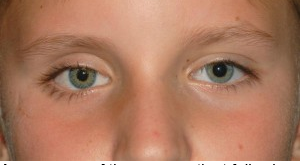
- When you attend the Prosthetics Department the Ocularist well take an impression of the socket and you will be fitted with a temporary prosthesis while a bespoke artificial eye (which matches the colour of the other eye) is being prepared. This process usually takes between 3-4 months but can take longer sometimes.)

How do I care for my artificial eye (prosthesis)?
You can sleep with the artificial eye, which should only be removed occasionally for cleaning with a mild detergent or contact lens cleaning solution. It is wise to use artificial tears 3-4 times a day and at bedtime to prevent the surface from drying. The artificial eye should be checked and polished at least once a year by an ocularist and usually needs replacing after 5-7 years. The socket will be checked at the same time to ensure that there are no problems. With good attention to socket and eyelid hygiene and maintenance of the artificial eye, problems such as discharge and discomfort are generally prevented.
Am I allowed to drive after removal of any eye?
For private car or motorcycle drivers, you can drive if you have normal vision and visual field in the other eye, have adjusted to the difficulty judging distance (altered depth perception) from loss of the eye, are not overly sensitive to light and have no other medical conditions that may stop you driving. If you have any doubt about your fitness to drive, please contact the DVLA.
Medication
Please bring a list of all your medicines or a current repeat prescription from your GP.
It is fairly common to have some nausea and pain after the removal of the eye. We will prescribe you some medications to help with your pain and any associated nausea. We will also send you home with one weeks course of oral antibiotics and some antibiotic drops to apply to the eye socket for the first month after the operation.
Contacts/further information
Please contact the Theatre Bookings Team in the Eye Department on 01223 274863 if you have any queries regarding your appointment for surgery. For urgent post-operative concerns please contact the Emergency Eye Service on 01223 217778 especially if you have any problems with your vision in the unaffected eye, excessive pain, excessive bleeding or a sticky discharge.
MyChart
We would encourage you to sign up for MyChart. This is the electronic patient portal at Cambridge University Hospitals that enables patients to securely access parts of their health record held within the hospital’s electronic patient record system (Epic). It is available via your home computer or mobile device.
More information is available on our website: MyChart
We are smoke-free
Smoking is not allowed anywhere on the hospital campus. For advice and support in quitting, contact your GP or the free NHS stop smoking helpline on 0800 169 0 169.
Other formats
Help accessing this information in other formats is available. To find out more about the services we provide, please visit our patient information help page (see link below) or telephone 01223 256998. www.cuh.nhs.uk/contact-us/accessible-information/
Contact us
Cambridge University Hospitals
NHS Foundation Trust
Hills Road, Cambridge
CB2 0QQ
Telephone +44 (0)1223 245151
https://www.cuh.nhs.uk/contact-us/contact-enquiries/