
Introduction
This information leaflet is for patients having a surgical jejunostomy. This will take place while you are an inpatient or may require a short hospital admission. Your healthcare team will explain what is involved and answer any questions you may have.
What is a jejunostomy tube?
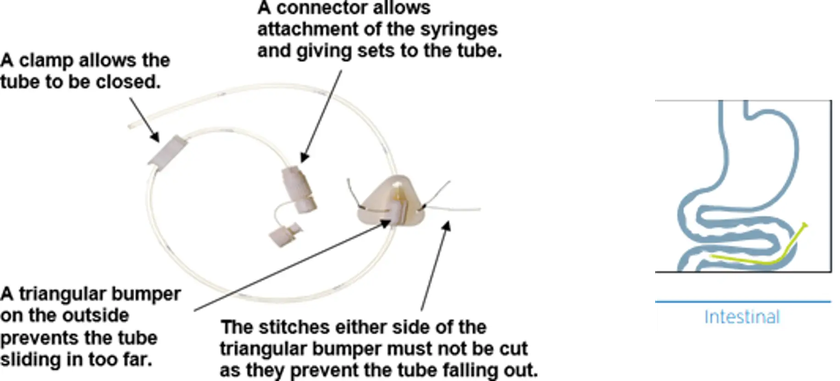
A jejunostomy tube is a soft tube placed through your skin into a part of your small bowel called the jejunum. The tube help as it bypasses the need to swallow, meaning nutrition and/or medications can be delivered directly into your small bowel.
Why do I have a jejunostomy tube?
You may be unable to take enough food and/or drinks by mouth to meet your nutritional requirements. This may be due to difficulty swallowing (dysphagia), an operation or medical condition.
How long do I need to have my jejunostomy tube?
This can vary depending on the reason why you have the tube. You will be regularly reviewed by a dietitian who will advise how long you may require your tube.
How to look after the surgical jejunostomy site
It is important to check that all the sutures securing the triangle plate to your abdomen are intact. This prevents your tube from falling out.
- For the first week: Day 1 – Day 7 after the surgical jejunostomy insertion
- Apply a small amount of Octenisan antimicrobial wash neat (do not dilute in water) to a cleaning pad or gauze.
- Carefully clean around the jejunostomy site starting at the area closest to the tube moving outward in a circular motion.
- Repeat this action (step 3) as above, using applying Octenisan if required.
- Clean the top and underside of the bumper (triangle). A cotton bud can be used to clean under the triangle.
- The Octenisan should be left for 1 minute before rinsing the skin around the jejunostomy tube and the bumper (triangle) using a clean pad moistened with warm water.
- Dry around skin and bumper (including the underside)
- Apply a pea size amount of the Mupirocin antimicrobial ointment in the area around where the tube exits the skin.
- Secure the PEG tube to your abdomen with tape to prevent it being pulled or dislodged. This also prevents traction on the stoma.
Can I have a bath?
- For the first two days after your tube is placed do not have a bath or shower. Instead wash using a flannel with the Octenisan antimicrobial wash.
- After Day 2 you may have a brief shower or bath. Do not soak or immerse the jejunostomy tube and exit site in water if having a bath.
From day 8 onward if the skin around your site is clean and dry, you may return to your normal bathing routine. If you have any concerns, please contact either your feeding company nurse or the nutrition nurse specialists.
After the first week: From Day 8 onward
- It is no longer necessary to use the Octenisan antimicrobial wash and the Mupirocin Ointment, but you will need to continue cleaning the jejunostomy site daily with warm soapy water. Dry well after cleaning.
Do I need a dressing to cover the tube?
Dressings are not usually required but some patients may use one to protect the sutures. If a dressing is used this will need to be removed to clean around the PEG site at least twice a week.
What if the sutures at the surgical jejunostomy site fall out?
The surgical Jejunostomy is secured to your abdomen with 3 sutures in the triangular external plate.
1. If 1 or 2 sutures come out (detached from your skin)
- Secure the triangle bumper of the surgical Jejunostomy tube to your abdomen with an adhesive dressing (Tegaderm or similar). This will prevent the tube from slipping (falling) out of the tract.
- You can continue to use the tube but should contact the Upper GI team who can arrange for the sutures replaced when possible.
- You can continue to feed but should stop if pain or leakage occurs when using the tube.
2. If you notice that all 3 sutures have come out (detached from your skin)
- It is important that you do not use the tube until the sutures have been replaced.
- Secure the triangle bumper of the surgical Jejunostomy tube to your abdomen with an adhesive dressing (Tegaderm or similar). This will prevent the tube from slipping (falling) out of the tract.
How to arrange for your Sutures to be replaced
Please contact Addenbrookes Dietician Department for the Upper GI Team on 01223 216 655 or the Upper GI Nurses on 01223 596 383 who can arrange suture replacement.
What nutrition (feed) is put through the tube?
Your Dietitian will discuss specialised liquid food (feed) that is designed to provide your body with the nutrients (carbohydrates, protein, fats, minerals and vitamins) that your body needs. A pump will be required for feeding. It is strongly recommended that only prescribed/approved feed, fluid and liquid medications are put through the tube to avoid damage and blockages.
When should I flush my PEG tube
It is important to flush your tube to prevent blockages.
When to Flush:
- Before and after each feed or medication.
- Between each individual medication dose.
- At least once daily if not feeding, typically every 4-6 hours.
Equipment Needed:
- 60ml enteral syringe
- Cooled boil water
Step-by-Step Flushing:
Position: Maintain an upright position (at least 30-45 degrees) when using the PEG tube for administration of feed, medication or water flushed. Remain upright 30 minutes to an hour after flushing or feeding to prevent reflux.
- Wash your hands with soap and water, dry then assemble your equipment
- Prepare: Draw the recommended amount of water into the syringe from a clean cup.
- Connect: Close the clamp on your PEG tube, open the cap from your PEG tube, attach the syringe, then re-open the clamp
- Flush: Slowly press the plunger, using a "push-pause" technique, pausing briefly every 5ml to push water through until complete
- Disconnect: Close the clamp on the tube before removing the syringe, close the cap then open the clamp.
- Secure the jejunostomy tubing to your abdomen with tape to prevent traction on the stoma.
Cleanliness: Rinse the syringe with warm water and store in a clean container for use throughout the day. Syringes need to be changed every 24hrs.
How long will my tube last?
- The surgical jejunostomy tubes can last for a few years. One way of increasing the life of your tube is to leave the clamp undone when the end connector is in place. This prevents the clamp squashing the tube.
- Clamp Placement: Move the clamp location up or down the tube periodically to prevent damage and prolong tube life.
What problems might I encounter after placement of a jejunostomy tube
Pain
The site where the tube enters can be painful for a few days after the procedure. Patients are usually encouraged to use pain killers (analgesia) regularly for the first two to three days following insertion.
Infection at the site of insertion
This can occur if the jejunostomy site is not kept clean and dry but is rarely serious. You will be provided with a PEG treatment kit containing Octenisan antimicrobial wash and Mupirocin antimicrobial ointment to clean the PEG insertion site for the first seven days. After this period patients are usually encouraged to clean with soap and water then dry well. Dressings are not usually required.
Leakage around the jejunostomy site
This may occur if the sutures becomes loose and the tube has moved or slipped. If leakage occurs when feeding or completing a water flush please contact the Upper GI team or Nutrition Nurses for advice.
Localised irritation (redness at jejunostomy site)
Daily site care at the jejunostomy site will prevent irritation. A protective skin barrier spray maybe applied to resolve any redness/ skin irritation caused by the leakage.
PEG tube related problems
Blockage of the tube
This can usually occur if the tube is not flushed immediately after the feed has completed or after giving some medications. Though blockages can be resolved, you are encouraged to prevent this by flushing before and immediately after feed.
Split or fracture in the tube
This can usually be repaired by trimming the tube just beyond the damage area and placing a new feeding end.
Who to contact about what?
You will be trained in all the necessary techniques to look after the feeding tube and what to do if you do have problems. However, your community nurses, GP, dietitian, and nutrition nurse will be available to help and support you. Your dietitian or nutrition team will provide regular follow up. The company delivering your feed also has a nurse helpline.
Contact details for the Upper GI Team and Dietitians
- Dietitians: 01223 216 655
- Upper GI Nurses: 01223 596 383
1. If you have any concerns about your feed or plastics order (including syringes and dressings) – contact your feed company:
- Nutricia Homeward: 0800 093 3672
- Abbott Hospital to Home: 0800 0183799
- Fresenius Kabi: 0808 100 1990
2. If you have any concerns about your PEG site or feeding pump – contact your feed company:
- Nutricia: 0800 093 3672
- Abbott: 0800 0183799
- Fresenius Kabi: 0808 100 1990
3. Please contact your local dietitian if you have any concerns about:
- any symptoms that suggest you are not tolerating your feed e.g. bloating, nausea
- your weight
- the amount or type of feed you take
- or if you need extra syringes or other supplies ordering
- or you want to discuss tube removal
4. Contact details for Enteral Nutrition Nurse Specialists
Monday – Friday (8am –4pm) excluding weekends and Bank Holidays
- Phone: 01223 216 037 Option 1 for Enteral Nutrition
- Mobile: 07710 365156
We are smoke-free
Smoking is not allowed anywhere on the hospital campus. For advice and support in quitting, contact your GP or the free NHS stop smoking helpline on 0800 169 0 169.
Other formats
Help accessing this information in other formats is available. To find out more about the services we provide, please visit our patient information help page (see link below) or telephone 01223 256998. www.cuh.nhs.uk/contact-us/accessible-information/
Contact us
Cambridge University Hospitals
NHS Foundation Trust
Hills Road, Cambridge
CB2 0QQ
Telephone +44 (0)1223 245151
https://www.cuh.nhs.uk/contact-us/contact-enquiries/