
Having sex or planning to have sex in the future? Read on….
This information is for you (and/or your parent/caregiver/responsible person) if you are someone with PKU and of childbearing potential.
These notes are part of the PKU pregnancy-planning programme, which aims to minimise the risks of conceiving with high blood phenylalanine (PHE) levels.
Why are we giving you this information?
Women with PKU can get pregnant and raised blood PHE levels can harm your baby.
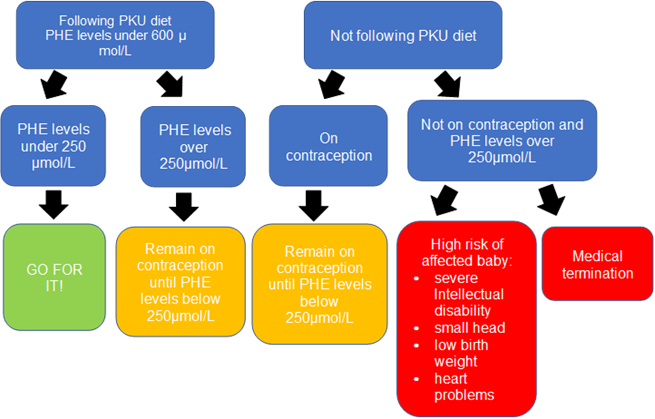
Always use effective contraception if you are not planning a pregnancy and if your blood PHE levels are above the recommended targets for pregnancy.
There are many safe forms of contraception. We would recommend a long-acting reversible form of contraception. Please discuss with your team if you would like more information. Integrated contraception and sexual health services across Cambridgeshire, Norfolk, Peterborough, and Suffolk (iCASH) are also able to provide helpful advice on contraception 0300 300 3030
If you are thinking about becoming pregnant, or you become pregnant, talk to your GP or specialist straight away.
If you are planning a pregnancy, we want this to be an enjoyable and safe experience for you. We encourage you to contact a member of the metabolic team at least three months before you decide to stop contraception.
Why all the fuss?
People with PKU who are not currently following a restricted PHE diet will have raised levels of PHE in their blood. High levels of PHE are toxic; during pregnancy, they will cross the placenta to the baby and can interfere with its normal development, possibly resulting in long-term or permanent damage. This happens very early on, often before the mother is aware of the pregnancy.
Raised blood PHE levels can seriously harm an unborn baby.
The main abnormalities associated with high blood PHE are:
- congenital heart disease
- damage to the brain
- small head
- low birth weight
- non-sustainable pregnancy
Development of the vital organs occurs early in the pregnancy. To achieve the best possible outcome, your PHE levels should be between 120 to 360 µmol/L before you decide to get pregnant. On dried spot tests we aim for 120 to 250 µmol/L for safety, due to the difference between these results and plasma levels (taken during clinic appointments).
What if I am pregnant and did not plan it?
Don’t panic….
- Contact the metabolic team as soon as you find out you are pregnant. We will see you as soon as possible to give you support, information and care.
- Move to zero protein exchanges.
- The most important thing is to reduce your PHE levels.
- Ensure that you take your protein substitute drinks/gels or powder. If you do not have any, let the team know.
- Inform your GP and request a prescription of 5mg folic acid.
- Start sending blood spots into the hospital three times a week – let the team know if you need a supply of lancets and Guthrie cards.
Monitoring your blood PHE levels
Frequent monitoring of your PHE allows the metabolic team to help you adjust your diet as required. This will help us ensure that you can safely become pregnant.
The metabolic team will arrange for you to have outpatient appointments to help you achieve the desired levels and assist with any issues that you may be experiencing. We recommend sending in three dried blood spot checks weekly prior to and during pregnancy. The target for the dried spot results is PHE levels of 120 of 250µmol/L.
What about medication to help control PHE?
Sapropterin is a medication that helps the body break down PHE and prevent a build-up of PHE in the blood. It is offered to individuals who have had a genetic test that shows a likelihood to respond to this treatment. It is licensed for use in pregnancy and can help reduce PHE levels in responders on the PKE diet who are struggling to reduce their PHE levels before or during pregnancy. If we feel this is appropriate for you, we will offer you a short trial to check if it makes a difference to your PHE levels, and we will only carry on if it is shown to work for you. Please discuss with our team if you would like more information.
Remember…
- Your metabolic team are here to help you have an enjoyable pregnancy and a healthy baby.
- It can be very distressing to have an unplanned pregnancy when you have PKU.
- Get in contact with us before you stop using contraception, even if you are not actively planning a pregnancy
Useful link
The National Society for Phenylketonuria (NSPKU) have some excellent resources on their website (opens in a new tab)
Contact telephone: 03030401090
Metabolic Team contacts
Specialist dietitians
Sarah Donald, Lisa Gaff and Eleni Leventea on 01223 348769
add-tr.cuhadultmetabolicsdietitians@nhs.net
Specialist nurses
Ruby Cross and Liz Morris on 01223 274634
Metabolic LDU unit 01223 274634
MyChart
We would encourage you to sign up for MyChart. This is the electronic patient portal at Cambridge University Hospitals that enables patients to securely access parts of their health record held within the hospital’s electronic patient record system (Epic). It is available via your home computer or mobile device
More information is available on our website: MyChart
We are smoke-free
Smoking is not allowed anywhere on the hospital campus. For advice and support in quitting, contact your GP or the free NHS stop smoking helpline on 0800 169 0 169.
Other formats
Help accessing this information in other formats is available. To find out more about the services we provide, please visit our patient information help page (see link below) or telephone 01223 256998. www.cuh.nhs.uk/contact-us/accessible-information/
Contact us
Cambridge University Hospitals
NHS Foundation Trust
Hills Road, Cambridge
CB2 0QQ
Telephone +44 (0)1223 245151
https://www.cuh.nhs.uk/contact-us/contact-enquiries/