

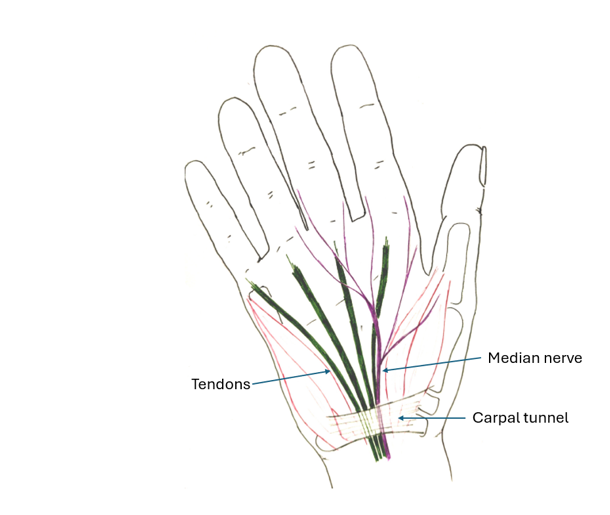
What is the carpal tunnel?
The carpal tunnel is a short tunnel which sits between the bottom of your palm and the base of your wrist (see image above). It is made up of small bones of the wrist and a band of soft tissue between the bones. Through the tunnel there are a group of tendons which glide back and forth to bend your fingers as well as the median nerve which is responsible for the sensation to your thumb, index, middle and half of your ring finger (see below), plus the movement of your hand.
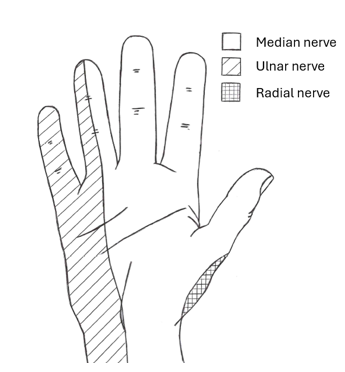
What is carpal tunnel syndrome?
Carpal tunnel syndrome occurs when there is an increase in pressure within the carpal tunnel. The median nerve becomes compressed (squashed) and is unable to function normally. Common symptoms include tingling, or pins and needles in the fingers and hand, particularly at night. Weakness in the hand can occur and you may find that you drop objects.
Surgery
The surgical procedure is known as a carpal tunnel release. This is where the band of soft tissue which forms the roof of the tunnel is released. Please refer to pre-surgery consent form for more information about your surgery.
Recovery
0-7 days post-operative care
- Your hand will be in a bulky bandage. Try and keep your hand elevated as much as possible.
- You may need to take Paracetamol to control pain.
- Keep your wrist, fingers and thumb moving as much as possible.
7-14 days-post operative care
- Discard the bulky dressings after a maximum of seven days after surgery, keeping the wound covered with a light dressing. The dressing needs to be changed regularly and can be used for up to 14 days. This keeps the wound clean and dry.
- Your sutures will need to be removed, usually at your GP surgery. This can happen 10-12 days after surgery, unless dissolvable sutures have been used. Dissolvable sutures will naturally dissolve over around 3 weeks after surgery.
- Continue to move your wrist, fingers and thumb. Some basic finger and thumb exercises can be found at the end of this leaflet for you to use if you are struggling with movement at all.
- It is fine to start to use the hand for light activities.
- If the wound is completely closed then you can wash your hands normally.
14 days post-operative care
- Massage the scar. This will prevent it from becoming tight and sensitive. Using E45 or aqueous cream, massage your scar using small firm circular motions for approximately two to three minutes, three to four times per day. Continue to do this until approximately 12 weeks after surgery.
- You should be able to make a full fist and be using the hand for light activities.
- You may occasionally experience mild discomfort if you press or lean on the scar area, this should pass in time.
- You can return to driving once you feel safe to do so.
Using the hand after 2-3 weeks
At this stage you should be returning to normal function and if you are not already doing so, you should be planning your return to work. The time taken to return to work will vary depending upon the type of work you do. If your job does not involve heavy lifting or repetitive tasks, getting back to work can be easier. The more manual the job the longer it will take you to build up strength and confidence in the hand. However, using the hand normally can be one of the best exercises you can do, as it improves movement and strength.
Up to 6 months
- At this stage the scar should be pale in colour, almost invisible.
- You should be using the hand normally and strength should have returned. Some patients can experience scar tenderness for up to six months and reduced power in the hand. With exercise and massage, these symptoms will resolve. If this does not happen, please make an appointment to see your GP.
- The majority of patients will no longer experience any symptoms of pins and needles/numbness in the hand. If you still have these symptoms, the surgery will have prevented this getting any worse.
Exercises
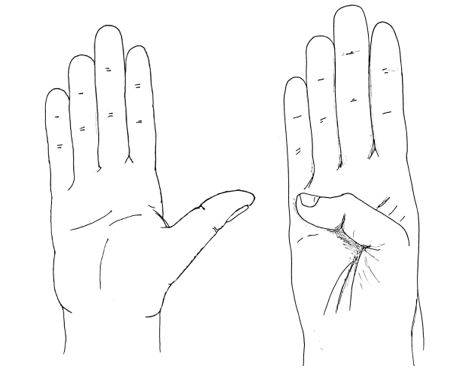
Start by stretching the thumb away from the palm. Bend the thumb forward across the palm to try to touch the base of the little finger. Hold for five seconds then repeat five times in total. Do these four times a day.
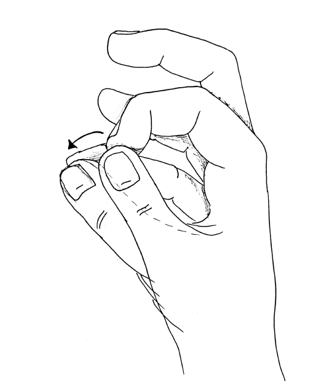
Touch the tip of your thumb to the tip of each finger. Hold for five seconds then repeat five times in total.
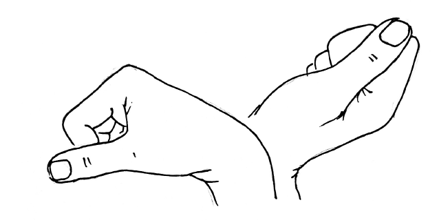
Keeping your fingers relaxed, gently bend your wrist forward and hold for five seconds then bend your wrist backwards hold for five seconds, repeat five times in total.
Do these four times a day.
Non-urgent advice: Any questions?
Use this space to write down your concerns to discuss with your consultant/therapist.
We are smoke-free
Smoking is not allowed anywhere on the hospital campus. For advice and support in quitting, contact your GP or the free NHS stop smoking helpline on 0800 169 0 169.
Other formats
Help accessing this information in other formats is available. To find out more about the services we provide, please visit our patient information help page (see link below) or telephone 01223 256998. www.cuh.nhs.uk/contact-us/accessible-information/
Contact us
Cambridge University Hospitals
NHS Foundation Trust
Hills Road, Cambridge
CB2 0QQ
Telephone +44 (0)1223 245151
https://www.cuh.nhs.uk/contact-us/contact-enquiries/