

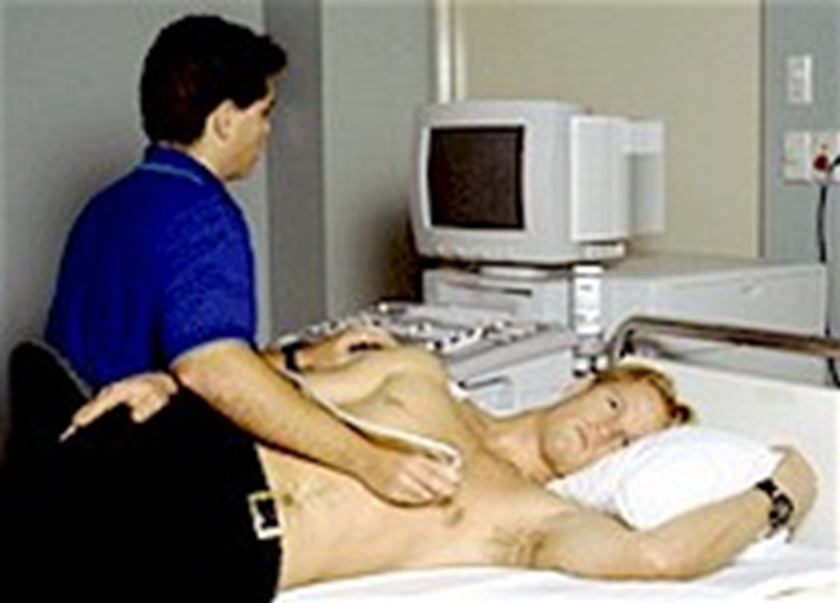
What is an echocardiogram?
An echocardiogram, often called an Echo, is a test that uses ultrasound to produce an image of the heart. It is a safe and effective way to assess the structure and function of the heart chambers (ventricles and atria), the heart valves and great vessels (aorta and pulmonary artery). It will assess the speed of blood flow and the pumping capacity of the heart.
An Echo should be painless, although some patients experience some local discomfort where the probe is placed on the chest. Please inform the echocardiographer if you experience any discomfort during the procedure.
An Echo does not use radiation or x‑rays. There are no risks associated with an Echo and it can be safely performed on adults, children and babies. There is no risk to unborn babies.
How is an echo performed?
There is no preparation needed, and you should eat and drink as usual, prior to the test. All clothing from the waist up will need to be removed. A hospital gown will be supplied. Women should try to avoid wearing a dress. If you require a chaperone, you may bring a friend or relative. Alternatively, the hospital can provide a chaperone at your request.
You will be asked to lie on your left side during the test. ECG stickers are placed on your chest. Wires are then attached to the ECG sticker to allow your heart rhythm to be monitored. The lights are dimmed to allow the best possible viewing of the images. A probe with gel is then placed on your chest. The probe is moved around the chest to allow the echocardiographer to view the heart from different angles.
Images of the heart are also obtained from areas near the stomach and under the chin. You may be asked to move slightly, breathe in or out, or hold your breath during the examination. This allows for the best possible imaging of the heart.
During the test, you may hear ‘swooshing’ noises from the ultrasound machine. These sounds are normal and help with the examination.
How long will it take?
The test will take approximately 30 to 40 minutes. Actual scanning time is usually about 20-25 minutes. You can leave immediately after the test and do not need to wait for your result.
How do I get my result?
Your Echo will be reported immediately after the test. The doctor who referred you for the test will be able to discuss the results with you at your next clinic appointment.
Sometimes your doctor may require the result urgently. In these cases, the department will ensure your doctor receives the report as soon as possible, but you will not be required to take the report.
In rare cases, the echocardiographer may need to discuss the result with a doctor before you leave.
Other important information
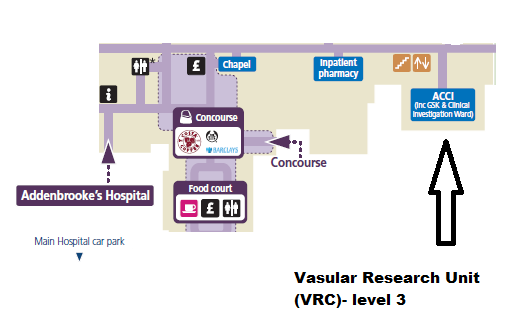
Take the lift (or the stairs) to level 3 in ACCI building. Turn right out of the lift and press the buzzer for Vascular Research Clinics. Once through the doors, the waiting room is the second door on the left. Please inform reception of your arrival as soon as you enter the department. There are many other tests being performed so you may not be called in order of arrival. You may bring a relative or friend in with you during the test.
If you have any queries regarding your appointment please telephone us on 01223 256653.
We are smoke-free
Smoking is not allowed anywhere on the hospital campus. For advice and support in quitting, contact your GP or the free NHS stop smoking helpline on 0800 169 0 169.
Other formats
Help accessing this information in other formats is available. To find out more about the services we provide, please visit our patient information help page (see link below) or telephone 01223 256998. www.cuh.nhs.uk/contact-us/accessible-information/
Contact us
Cambridge University Hospitals
NHS Foundation Trust
Hills Road, Cambridge
CB2 0QQ
Telephone +44 (0)1223 245151
https://www.cuh.nhs.uk/contact-us/contact-enquiries/