


What are Ankle Brachial Pressure Indices (ABPI)?
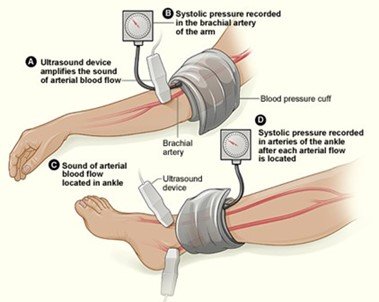
This test may also be called “A Doppler test”. The test involves taking a blood pressure reading of your upper arms (at the level of the brachial artery) and ankles. The blood pressure at your arms and ankles should be the same when you are lying down. In people with narrowings or blockages in the arteries in their legs the blood pressure at the ankle will be lower.
This test is a safe and effective way to assess if there is any disease in the arteries in your legs. This will allow the consultant to plan the appropriate treatment for you.
The test is painless and does not use any radiation or needles.
Where do I go?
The Vascular Studies Unit (VSU) is on Level 5 of the Addenbrooke’s Treatment Centre (ATC). Please inform reception of your arrival straight away. There are often other clinics in progress, so you may not be called in order of arrival.
What is consent?
Consent is the process by which you give permission to healthcare professionals to provide your care and treatment. It may be implied (offering your arm for a blood pressure reading) or formal (signing a formal consent form for an operation). In either case your consent must be given voluntarily, and you must have all the information you need to make a decision. Before your test is performed, you must give your consent. If you feel you do not have enough information or do not understand the procedure, please ask.
How is the test performed?
There is no preparation needed and you may eat and drink as usual prior to the test.
A clinical vascular scientist will perform and interpret your test. . You will be asked to remove your shoes and socks, roll up your sleeves and lie on the couch. A blood pressure cuff will be placed around your arms and ankles. A small amount of gel will be placed on your arm and your ankles, and a pen-like device called a handheld Doppler will be used to listen to the blood flow. The blood pressure cuffs will be pumped up to determine the blood pressure at your arms and ankles. This may feel tight but should not be painful.
The investigation takes up to one hour. During the test, you may hear some “swooshing” noises from the handheld Doppler. These sounds are normal.
If you have any breathing difficulties, heart problems or balance problems please let the clinical vascular scientist know before you walk on the treadmill. We may need to adapt the test accordingly.
Risks/Side Effects
There are no risks or side effects associated with this test.
What happens next?
The clinical vascular scientist can comment briefly on the findings and will write a report for the consultant who requested the test. You will be able to discuss the results of this investigation fully with the referring team at your next outpatient appointment.
In rare cases, the clinical vascular scientist may need to discuss the result with a doctor before you leave.
Other important information
You may bring a relative or friend in with you during the test or request a chaperone if you would like one.
If you require further information, please do not hesitate to call the Vascular Studies Unit (VSU) on 01223 348117.
Privacy & dignity
If you would like to request a same sex clinical vascular scientist to perform your scan please inform us in advance so that arrangements can be made, where possible. Same sex toilets are available in the department.
We are smoke-free
Smoking is not allowed anywhere on the hospital campus. For advice and support in quitting, contact your GP or the free NHS stop smoking helpline on 0800 169 0 169.
Other formats
Help accessing this information in other formats is available. To find out more about the services we provide, please visit our patient information help page (see link below) or telephone 01223 256998. www.cuh.nhs.uk/contact-us/accessible-information/
Contact us
Cambridge University Hospitals
NHS Foundation Trust
Hills Road, Cambridge
CB2 0QQ
Telephone +44 (0)1223 245151
https://www.cuh.nhs.uk/contact-us/contact-enquiries/