

This leaflet has been designed to inform and advise you relating to the monitoring and care that your child will require while they wear contact lenses.
This video, entitled ‘Contact lens care for infants and children a guide for parents 2’ (opens in a new tab) has been compiled to accompany this leaflet.
Why does my child need to wear a contact lens?
Your child needs to wear a contact lens because of either of the following:
- He/she has had surgery to treat congenital cataracts.
The natural lens focuses light onto the retina to give a clear image. The natural lens is removed during cataract surgery –this leaves the eye without a lens (aphakic). Although it is routine to implant an artificial lens during adult cataract surgery, in babies or infants the eye can be too small and so we use either contact lenses or strong glasses instead.
2. He/she is either very short-sighted (myopic) or very long-sighted (hypermetropic) in one or both eyes.
Strong glasses can distort peripheral vision to be distorted or can be very heavy on the nose, contact lenses can improve the quality of vision and be better tolerated.
3. There is a large difference in the focusing power in each eye
If your child has one very long or short-sighted eye, the difference in the image size caused by the different strengths of glasses lenses can make it difficult for the child to use both eyes together to get 3D vision. The image size difference is much less when using contact lenses.
Isn’t my child too young to wear contact lenses?
There is no age limit for wearing a contact lens. It can be difficult to insert and take out contact lenses every day in children, so we use specialist soft lenses which can be kept in day and night, changed every few months by our contact lens fitter. Wearing lenses in this way does increase the risk of irritation and infection, so we will gradually teach you how to manage the contact lenses yourself, so that the lenses can be taken out between visits
What to expect at a contact lens clinic appointment
These are multi-disciplinary clinics, so your child is likely to see an orthoptist for vision assessment, a nurse for eye drops, the contact lens fitter and your ophthalmologist. The clinic visits can last for up to two hours.
If your child is already wearing contact lenses, the contact lens practitioner will examine your child with these in first, prior to removing the contact lens(es) for a full eye check. The lens is re-inserted following the examination. Please bring a bottle, toys or snacks so that your child is as settled as possible during the procedure.
Children using extended wear contact lenses need to be seen on a very regular basis, every two to three months to check there is no sign of infection and to change the lens.
These appointments are very valuable, so if you are unable to attend your outpatient appointment please be sure to contact clinic 3 reception to arrange an alternative appointment.
Charges and exemption forms
There is no charge to children under 16 years of age, or in full time education under 19 years, for contact lenses supplied through the Hospital Eye Service (HES). If you need a replacement lens you will be asked to sign an exemption form HES(P), parents sign on behalf of children.
Contact lenses cannot be supplied without a signature. If you prefer a lens to be posted to you instead of having an appointment to collect it, you will be asked to sign in advance that you have received it.
Unfortunately these statutory forms are designed principally for the supply of spectacles at an appointment, which causes some anomalies in the wording when used for contact lenses.
Are there different types of lenses?
There are two main types of contact lenses, rigid and soft, which each require specific sterilising and cleaning solutions.
Most contact lenses we prescribe for children in the clinic are soft hydrogel lenses made of silicone. These lenses are soft and flexible like soft polythene or cling-film. The high focusing power lenses have a central more rigid area. Rigid gas permeable lenses are usually smaller in diameter than soft lenses and are not flexible.
Contact lens solutions
Babies and very young children, who sleep with their lens(es) in, will only need sterilising solution for occasional use (in which to store a lens that has fallen out). Initially you will be provided with a small ‘sample bottle’ of solution.
However, in the longer term, you will need to either purchase solution from an opticians or chemists, or obtain some (with a prescription from clinic) through our outpatient pharmacy.
The hospital’s outpatient pharmacy supplies either Opti Free Express (for soft contact lenses) or Boston Advance cleaner and conditioning solution (for gas permeable lenses). One bottle of Opti Free Express should last for three months if only one lens is worn.
A pack containing solution also usually contains a storage case for the lens(es).
Can the contact lens tear whilst it is in my child’s eye?
Rips and tears of a soft contact lens can occur during handling and cause irritation but no damage to the eye. Children will tend to rub an uncomfortable lens out of the eye.
It is important the time your child is without their contact lens correction is minimised, since an unfocused image will interfere with visual development. So please contact us quickly to arrange a replacement if you have not got a spare lens.
The lens materials used for babies and young children are of a special type that combines suitability for long term wear with stability in the extreme situations that children subject them to.
Even so all children will lose lenses from time to time; some far more frequently than others. In the event of loss notify the paediatric ophthalmology nurses or clinic 3 by phone.
Spare lenses
Babies are usually supplied with spare lenses so that you have a replacement to hand if in case of damage or loss. If you use your spare lens please make sure that you re-order another spare straight away. Do not wait until the spare lens is also lost before ordering another.
Benefits and risks
If your child has been prescribed a contact lens or lenses, it is because this is considered to provide the best chance for him/her to develop their optimum visual ability.
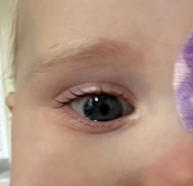
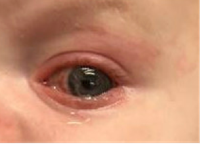
The most serious risk of wearing a contact lens is the risk of infection. An infection will make the eye red, uncomfortable and sticky.
Questions and problems
My child’s eye is sticky but white with no discomfort, or my child is rubbing their eye more than usual
- Contact the paediatric ophthalmology nurses for advice, photos are helpful
- Start instilling preservative free levofloxacin or chloramphenicol drops 6 times a day – ensure that you always have a box at home (we can give you some in clinic).
- If your child only wears a contact lens in one eye but the other gets sticky due to conjunctivitis, start using the preservative free levofloxacin or chloramphenicol in both eyes, being careful to use a separate dropper for each eye to prevent contamination
My child’s eye is red and painful with sensitivity to light
- Contact the paediatric ophthalmology nurses for advice straight away, photos are helpful
- If you have had training and feel confident about removing your child’s contact lens, then please do
- Start preservative free levofloxacin or chloramphenicol drops 6 times a day
- The nurses will arrange an urgent review at Addenbrooke’s or direct you to the team at your local hospital
What should I do if…
My child’s contact lens has fallen out
- If you have found the lens and it appears undamaged pick it up and put it in the contact lens case with fresh solution to disinfect and re-hydrate for 6 hours. If it has become hard and brittle it should not be used again.
- If the lens looks damaged after it has been disinfected for 6 hours, or if it was over two months’ old discard it and insert the spare lens if you are able.
- Re-insertion can be difficult in the early stages. Several attempts may be needed. If you have made 3–4 unsuccessful attempts, take a short break and then try again, or swap over to the other parent/carer if possible.
- Anaesthetic drops provided in your pack may be used to help with lens insertion in the early stages. These should not be used routinely once parents have become more confident with CL handling (usually after one or two successful insertions).
- If you cannot re-insert the lens or do not have a spare lens, please contact the paediatric ophthalmology department using the emergency contact details. An urgent appointment will be arranged-usually within 48 hours..
Care requirements
Most babies and children of all ages tolerate contact lenses very well. But, wearing contact lenses all the time could sometimes make their eyes dry, result in eye rubbing and lead to the lens falling out. This may become more evident in very warm weather, or if they are exposed to central heating in the winter months. It is a good routine to check every morning that your child’s lens(es) are in place!
If the eye looks dry (has lost its “sparkle” or looks misty at times) ask us for some lubricating eye drops to instil into your child’s eyes to ease their irritation and make them more comfortable.
Your child’s contact lens will normally need to be changed every three months. Initially you will be invited back to clinic 3 for the contact lens practitioner to do this, until you feel confident and competent to undertake this task at home. Your child’s contact lenses will normally be posted to your home address.
Restrictions
Some parents are happy to remove their child’s contact lens every night for sterilization and insert it in the morning. However, most parents find this quite daunting initially and it is quite safe for the lens to be kept in all the time, until you feel confident toremove the lens nightly.
Keeping the lens in all the time does pose a small risk of getting an eye infection, but these usually resolve quickly provided treatment is started promptly.
Yes, it is perfectly safe for your child to continue with their immunization schedule as they grow. No special precautions need to be taken.
Swimming pools and bathwater contain a type of organism (acanthamoeba) which can cause serious infection in contact lens wearers. Ideally contact lenses should not be worn when swimming, however, if you do decide to take your child swimming ensure that well fitting goggles are worn and your child does not go under water.
It is perfectly safe for your child to continue to wear their contact lens whilst in the bath but try to minimize the amount of bathwater going in his/her eyes.
Caution is advisable to avoid your child from getting sand in their eyes and to prevent subsequent eye rubbing which could dislodge the lens and / or cause damage to their eye(s).
Alternatives
Please be sure to ask about any alternatives to your child’s plan of care during their out patient appointment consultations.
Contacts and further information
If you have any concerns relating to your child’s immediate health please contact your general practitioner (GP). Alternatively, if the matter is a query relating to your child’s diagnosis and is non urgent, please be sure to ask your questions at your child’s next outpatient appointment, or, contact one of the following:
Paediatric Ophthalmology Nurses
Tel: 01223 596414 Monday-Friday 08:00 – 17:00
If no response is gained from the paediatric ophthalmology nurses within a day of leaving a message, please ring the emergency clinic number on 01223 217778.
Orthoptic Department
cuh.orthoptics@nhs.net Tel: 01223 216528
Paediatric Ophthalmology Secretary
Emergency eye clinic (urgent concerns out of office hours)
add-tr.emergencyeye@nhs.net Tel: 01223 217778
Clinic 3 (via Contact Centre)
Contact Lens Practitioners:
Ali Akay
ali@shephardandakay.co.uk ; ali.akay1@nhs.net
Elanor Turnbull
We are smoke-free
Smoking is not allowed anywhere on the hospital campus. For advice and support in quitting, contact your GP or the free NHS stop smoking helpline on 0800 169 0 169.
Other formats
Help accessing this information in other formats is available. To find out more about the services we provide, please visit our patient information help page (see link below) or telephone 01223 256998. www.cuh.nhs.uk/contact-us/accessible-information/
Contact us
Cambridge University Hospitals
NHS Foundation Trust
Hills Road, Cambridge
CB2 0QQ
Telephone +44 (0)1223 245151
https://www.cuh.nhs.uk/contact-us/contact-enquiries/