

The Histopathology Department Cambridge University Hospitals NHS Foundation Trust (CUH) provides a comprehensive range of histological and cytological pathological services. These services include the routine and specialised examination of tissue samples (including immunocytochemistry and electron microscopy), diagnostic screening of body fluids and aspirates, and coroner's autopsies.
These services are fully supported and led by Royal College of Pathologists (RCPath) registered consultant clinical staff and Health and Care Professions Council (HCPC) registered senior biomedical scientists.
Opening hours
The Histopathology Department is open for the routine examination of specimens from 08:30 to 17:30 Monday to Friday and on Saturday for deliveries from 09:00 to 12:00. It also provides an on-call service for renal and liver transplant and out of hours intra-operative frozen section.
Contact details
Departmental Clinical Lead: Dr Michael Eden
Histopathology Manager: Zahrah Rosun
Contact Histopathology and cytology via its Enquiries line
Telephone: 01223 217163
Histopathology service update
The Histopathology and Diagnostic Cytology laboratory has relocated to 1000 Discovery Drive on the Cambridge Biomedical Campus.
UKAS Accreditation Scope
Histopathology department, including 1000 Discovery Drive location is accredited to ISO 15189:2022 standards. Schedule of accreditation can be found here. (opens in a new tab)
Immunohistochemistry service update
As part of our ongoing commitment to service improvement and innovation, the Histopathology Department is progressively transferring selected immunohistochemistry (IHC) tests from the Leica BOND-III staining platform to the Leica BOND PRIME platform. This transition is being implemented in phases to ensure continuity and quality of service.
During this period, any antibodies that have been transferred to the BOND PRIME platform will temporarily fall outside the scope of UKAS accreditation until an Extension to Scope assessment has been completed and accreditation has been formally granted. The department will continue to verify and monitor all testing processes in line with established quality assurance standards.
Please see below list of antibodies that are now being carried out on the BOND PRIME platform.
Histopathology turnaround time
Due to a significant increase in the number Histopathology investigations since the end of the COVID pandemic the Cambridge Histopathology laboratory has not been meeting the turnaround time reporting standards to which we aspire:
- 80% within 7 days
- 90% within 10 days
- 95% within 21 days
An improvement programme is on-going and the laboratory continues to work on several initiatives to increase capacity. This includes the use of digital imaging (replacing microscopy) and implementation of new technologies.
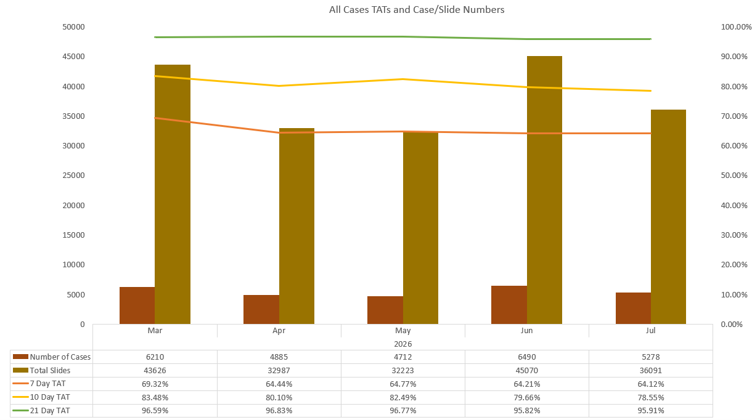
Information on the current turnaround time (TAT) performance for all cases is shown below:
| Month | 7 Day TAT | 10 Day TAT | 21 Day TAT | Number of Cases | Total Slides |
|---|---|---|---|---|---|
| Month Apr | 7 Day TAT 64.44% | 10 Day TAT 80.10% | 21 Day TAT 96.83% | Number of Cases 4885 | Total Slides 32987 |
| Month May | 7 Day TAT 64.77% | 10 Day TAT 82.49% | 21 Day TAT 96.77% | Number of Cases 4712 | Total Slides 32223 |
| Month Jun | 7 Day TAT 64.21% | 10 Day TAT 79.66% | 21 Day TAT 95.82% | Number of Cases 6490 | Total Slides 45070 |
| Month Jul | 7 Day TAT 64.12% | 10 Day TAT 78.55% | 21 Day TAT 95.91% | Number of Cases 5278 | Total Slides 36091 |
| Month Aug | 7 Day TAT 61.75% | 10 Day TAT 78.86% | 21 Day TAT 96.51% | Number of Cases 5767 | Total Slides 40499 |
If you require an urgent result, please contact the department via its enquiries line ext. 217163 (if external 01223 217163) or email histopathology so that this can be escalated appropriately.
Fresh tissue for whole genome sequencing (WGS) - RNA later pathway
Overview
RNAlater is available for solid tumour WGS submissions to East GLH or via CUH histopathology. It stabilises DNA and allows safe storage and transport without immediate freezing. Local validation confirms its suitability for WGS workflows.
Requesting RNAlater
Phone 01223 348213 (Section leader) or email here.
We supply 6 x 5 mL RNAlater universals per request.
How to use RNAlater
- Trim tissue to ≤5 mm; immerse in ≥5:1 RNAlater:tissue.
- Storage: RT ≤1 week; 4 °C ≤1 month; for archival, –20 °C/–80 °C indefinitely after overnight at 4 °C to allow penetration.
- After-hours: place fresh tissue in RNAlater and notify Histopathology the next working day.
Where to send external RNAlater samples needing purity assessment
1000 Discovery Drive, Trumpington, Cambridge, CB2 0AX
Further Information and request form for sending samples to Histopathology in RNA later are available here (opens in a new tab)