

What is a promontory stimulation assessment?
This leaflet is for patients in assessment for a cochlear implant who have been booked for a promontory stimulation appointment. This specialised assessment looks at the response of the auditory (hearing) nerve to electrical stimulation.
Who needs a promontory stimulation assessment?
You may have long-standing deafness, or a medical condition which means we wish to check the function of this nerve. We know that an active auditory nerve is needed in order for a cochlear implant to work.
What will happen at my appointment?
First you will meet the audiologist, who will talk through the procedure with you and answer your questions. Then you see the consultant, who will carry out the procedure with the audiologist.
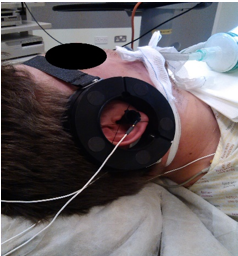
The procedure introduces electrical current very gently near the bone of your inner ear, called the promontory. You will be asked what you hear or feel during this electrical stimulation.
In preparation, a sticky pad is placed on your forehead. (The forehead may be cleaned first to improve adhesion.)
The consultant will look down your ear canal and remove any ear wax. Then some local pain relief will be applied to your ear drum. Next a soft ring of foam is placed around your ear. When the ear drum is numb, a needle is gently passed through the ear drum to rest on the promontory. The needle rests there during the procedure, held by the foam ring. Electrical current will be introduced through this needle. The procedure takes approximately 30 minutes. You will be asked questions about any sensation of sound.
When do I get the results?
Immediately after the procedure, the consultant will explain the findings.
After the procedure
The tiny hole in the ear drum will heal, usually within 48 hours. During this time, keep the ear dry.
Risks of promontory stimulation
It is possible that infection may arise in the stimulated ear. Every precaution is taken to avoid this. If you experience any pain, redness or discharge, please go to your GP.
Alternatives
There is no other way to check the function of the hearing nerve.
Further information
For further information, please contact your cochlear implant key worker, or the lead audiologist at the emmeline centre.
We are smoke-free
Smoking is not allowed anywhere on the hospital campus. For advice and support in quitting, contact your GP or the free NHS stop smoking helpline on 0800 169 0 169.
Other formats
Help accessing this information in other formats is available. To find out more about the services we provide, please visit our patient information help page (see link below) or telephone 01223 256998. www.cuh.nhs.uk/contact-us/accessible-information/
Contact us
Cambridge University Hospitals
NHS Foundation Trust
Hills Road, Cambridge
CB2 0QQ
Telephone +44 (0)1223 245151
https://www.cuh.nhs.uk/contact-us/contact-enquiries/