
Background
We invite you to take part in a research study to test whether a research, 7-Tesla MRI scanner using ‘parallel transmit’ sequences (a way of taking pictures of your brain more evenly) gives us more information about the cause of your epilepsy than the standard MRI scan you have already had.
Why have I been chosen?
Your doctors are evaluating whether you would benefit from an operation to control your epilepsy. This operation is more successful if your doctors can see an abnormality in the brain on an MRI scan. Your doctors have chosen you because they think you have an abnormality that is too small to see on a standard MRI scan, but that we might be able to see with this research MRI scanner, because it can take more detailed pictures of your brain.
What is the purpose of the study?
To evaluate whether parallel transmit 7T MRI scans are able to detect brain lesions that cannot be seen with standard 3T MRI scans. The scanner was designed for research and so has not been CE marked (approved by the European Union) for clinical use and is being used ‘off-label’. This study will help to decide the best way to use the scanner to take pictures of the brain in patients who have epilepsy. Your clinical team have conducted a risk assessment and believe that the potential benefits of the scan in finding the cause of your epilepsy outweigh any risks.
We will also be assessing the impact of the scan on the NHS in terms of health economic costs, weighing up its benefits against its price. We will also be testing some new, computerised methods for looking at the scans, and whether they help the radiologist to do the best possible job of finding the cause of your epilepsy.
Do I have to take part?
You do not have to take part, and you are free to withdraw from the study at any time, with no need to give a reason. Withdrawal will not affect the standard of care that you will receive. If you are unhappy or upset at any point you are free to withdraw from the study but any data already collected will be kept.
What does participating involve?
After completing a consent form and making sure that you understand what will happen, we will do a safety questionnaire to make sure that you do not have any metal in your body that would make it unsafe to have a 7T MRI scan. Even though you have already had a 3T MRI scan, because the magnet in the 7T scanner is stronger, allowing us to take more detailed pictures, we need to be a bit more careful. The 7T MRI scanner looks and feels very similar to the 3T MRI scanner, as shown in the photograph below.
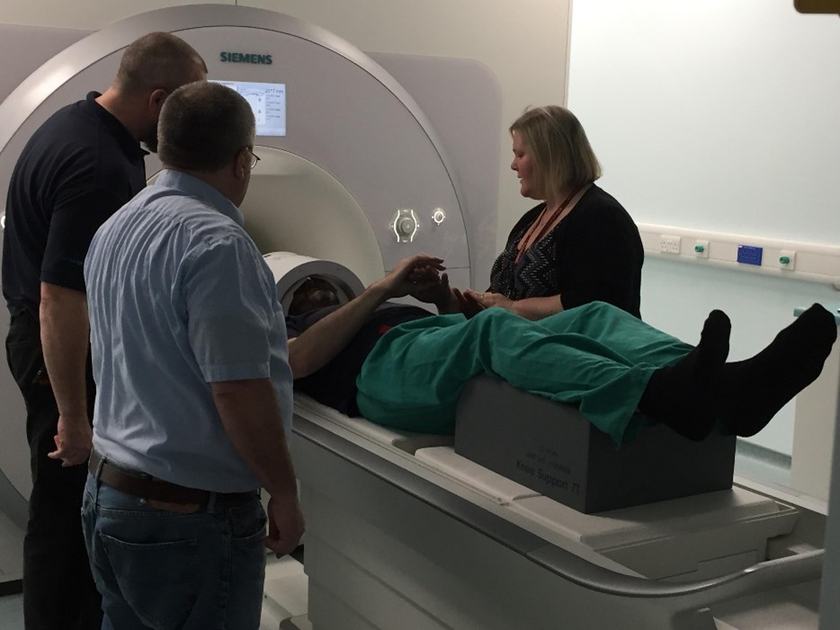
Nine out of ten people find the 7T MRI scanning at least as comfortable as MRI scanning with normal, less powerful, scanners. Some people report mild dizziness or a metallic taste in their mouth as they enter the scanner, so we take care to do this slowly and in conversation with you. The scanner takes several short scans, between 1 and 15 minutes each, lasting typically 60 minutes in total. There are no injections or X-rays used.
Only your usual doctors and their team will have access to your medical records, but researchers from Cambridge will be able to see your brain scan, and will be told your age and sex, some details about the type of epilepsy you have, what treatments you receive, and how well your doctors are able to control your seizures in future. Every six months, clinicians may contact you to ask you to complete some questionnaires about your epilepsy, what medications you are taking, how your mental and general health are, and what your quality of life is. If you agree, we would also like to share this information with legitimate researchers in other places, to help them to develop better care for epilepsy patients and patients with other brain problems.
The scans will be stored on secure hospital systems and on secure University systems, along with your name, date of birth and hospital number, to make sure that they do not get lost.
What are the possible disadvantages and risks of taking part?
The MRI scanner can be loud, so you will be given ear covers and/or earplugs to block out some of the noise.
The 7T MRI environment is quite confined, and people who are uncomfortable in small or confined spaces may not be able to participate. If this should be you, remember that you may withdraw from the study at any time.
Some people experience mild dizziness or a metallic taste in their mouth as they enter the MRI scanner. This sensation is caused by your head moving through the magnetic field; it is nothing to worry about and will pass once you are inside the scanner.
During the scan, some people experience a little tingling in their fingers or arms. This is nothing to worry about, but if you find it uncomfortable you can stop the scan at any time.
If you have any metal implants, for example after hip or knee surgery, we will ensure that these are safe in our MRI scanner. Generally, MRI is a safe, non-invasive imaging technique.
While there is no evidence to suggest that MRI is harmful during pregnancy, the Department of Health advises against scanning pregnant women with this type of scanner. We do not to test for pregnancy as routine but if you think you might be pregnant you should not take part in this study.
What are the possible benefits of taking part?
It is possible that the scan will reveal a brain problem that your doctors could not see on your previous scan. It might be possible to do surgery that could not otherwise have been done, or to conduct surgery more safely, or to avoid the need for placing electrodes in your brain to find the source of your seizures. However, it might also be that this scan provides no additional information and does not change your surgical options.
Will I be told about the results from this study?
Your usual doctor will discuss the results of your scan with you in clinic, and will inform your GP.
What if there is a problem?
If you have a concern about any aspect of the study, you should ask to speak to the radiographers who will do their best to answer your questions. In the first instance, please contact Dr Thomas Cope at Addenbrooke’s Hospital or Prof Chris Rodgers at the Wolfson Brain Imaging Centre. If you remain unhappy please contact the Patient Advice and Liaison Service (PALS) on 01223 216756 or by email cuh.pals@nhs.net
Who will have access to my medical records?
Only your usual doctors and the radiographers conducting your scan. Researchers will have access to the limited information above.
For monitoring and clinical governance purposes, relevant sections of your medical notes and data collected during the study may be looked at by approved individuals from authorised regulatory authorities or from the NHS Trust where it is relevant to you taking part in this research.
How will we use information about you?
People who do not need to know who you are will not be able to see your name or contact details. Your data will have a code number instead. We will keep all information about you safe and secure.
When the results of the study are available, they will be published in a PhD thesis and medical journals, but we will write our reports in a way that no one can work out that you took part in the study. If you would like to obtain a copy of the published results, please ask the research team and indicate this on your consent form. We will store the data and scans collected as part of this study indefinitely in research databases. With your consent, we will share anonymised forms of this data and scans with other researchers, including commercial partners in the UK and overseas, both directly and through publication in research databases.
With your consent, we will also add this research scan to your medical records.
Cambridge University Hospitals NHS Foundation Trust (CUHNFT) is the Sponsor for this study based in the United Kingdom. CUHNFT and the University of Cambridge will be using information from you and/or your medical records in order to undertake this study and will act as joint data controllers. This means that both organisations are responsible for looking after your information and using it properly. CUHNFT and the University of Cambridge will keep identifiable information about you for a minimum of 10 years and possibly indefinitely in accordance with good research practice, to ensure that your scan remains available for clinicians. Within the University of Cambridge, the data we obtain will be stored on a secure computer network and only members of the WBIC or members of the research team will have immediate access to identifiable data. Anonymised data will be shared as explained above.
Your rights to access, change or move your information are limited, as we need to manage your information in specific ways in order for the research to be reliable and accurate. If you withdraw from the study, we will keep the information about you that we have already obtained. To safeguard your rights, we will use the minimum personally-identifiable information possible.
You can find out more about how we use your information using the following links:
- For Cambridge University Hospitals NHS Foundation Trust or email the Data Protection Officer at: cuh.gdpr@nhs.net
- For University of Cambridge (opens in a new tab) or email the Information Governance team at: researchgovernance@medschl.cam.ac.uk
What are your choices about how your information is used?
- You can stop being part of the trial at any time, without giving a reason, but we will keep information about you that we already have
- If you choose to stop taking part in the trial, we would like to continue collecting information about your health from your hospital. If you do not want this to happen, tell us and we will stop.
- You have the right to ask us to remove, change or delete data we hold about you for the purposes of the study. We might not always be able to do. If so, we will tell you why we cannot do this
- If you agree to take part in this trial, you will have the option to take part in future research using your data saved from this trial.
Who is organising and funding the research?
This study is organised by Cambridge University Hospitals. Dr Thomas E Cope is the Chief Investigator and the protocol author. Professor Chris Rodgers, Head of 7T MRI physics, is a key collaborator. The study is funded by the Medical Research Council and the cost of the scan is covered in part by the NHS.
Who has reviewed the study?
All research in the NHS is looked at by an independent group of people, called a Research Ethics Committee, in order to protect patient safety, rights, wellbeing and dignity. This study has been approved by the West Midlands - Solihull Research Ethics Committee.
We are smoke-free
Smoking is not allowed anywhere on the hospital campus. For advice and support in quitting, contact your GP or the free NHS stop smoking helpline on 0800 169 0 169.
Other formats
Help accessing this information in other formats is available. To find out more about the services we provide, please visit our patient information help page (see link below) or telephone 01223 256998. www.cuh.nhs.uk/contact-us/accessible-information/
Contact us
Cambridge University Hospitals
NHS Foundation Trust
Hills Road, Cambridge
CB2 0QQ
Telephone +44 (0)1223 245151
https://www.cuh.nhs.uk/contact-us/contact-enquiries/