

You have been given this leaflet because your pain clinic clinician thinks the Addenbrooke’s pain management programme may help you to develop self-management strategies for living with chronic pain. This leaflet aims to give you enough information to help you decide whether you would like to be referred for a programme assessment.
Our mission for patients participating in the pain management programme is:
To empower patients to gain confidence, change their perspective on pain for the better and improve their participation in life.
Who is the programme for?
The programme is for people who live with chronic pain. To take part, you will already be under the care of the pain clinic. You will have been reviewed by a consultant and may have had various appointments with the clinic nurses or other professionals within the clinic.
The programme is recommended because there is no cure for chronic pain. It sets out to give people the knowledge and tools to self-manage their pain in the long term. If you are still undergoing investigations into your chronic pain or seeking medical management, the programme may not be for you at this time.
Many participants on the programme say pain has taken over their lives. The programme is designed to help people get their lives back: to help people work towards achieving realistic goals, increase activity, lift their mood, and see improvements in their relationships. If you want to achieve these things, then the pain management programme may be for you.
What does the programme involve?
The programme is held on Mondays to Thursdays for three consecutive weeks – a total of 12 days – in groups of around eight people. Although it is an outpatient programme, some people qualify for accommodation during the programme.
Each group is reviewed after one month, six months and a year. You are expected to attend all sessions of the programme and reviews. If you cannot attend one of your group’s review days, you will be offered a review with a different group. Once you reach your twelve-month review point, you will be discharged from the pain clinic back to the care of your GP.
We understand the programme involves a big commitment from you. We suggest you avoid making significant plans for the Fridays or weekends during the programme, so you have time to rest and practice some of the strategies introduced
Who runs the programme?
Psychologists lead a team of nurses, physiotherapists and occupational therapists. We do not see pain as just a physical problem. We believe it involves your thoughts, your mood, your activities and your relationships, amongst other things. That is why a range of different staff are involved to help build coping strategies in different areas of your life.
The psychology ideas we use are based on cognitive behavioural therapy and compassion focused therapy. These ideas may help you to think differently about your challenges and identify coping skills.
The responsibilities of the programme team include:
- To provide evidence-based approaches for self-management of chronic pain
- To treat you with respect and kindness
- To ensure a supportive environment for you to try out new skills
The responsibilities of the programme participants are:
- To be open minded
- To commit to attend all sessions
- To participate in the activities and discussions
- To try out the strategies and skills in your everyday life.
What would I do on a programme?
An example of what your days may look like on the programme is shown below:
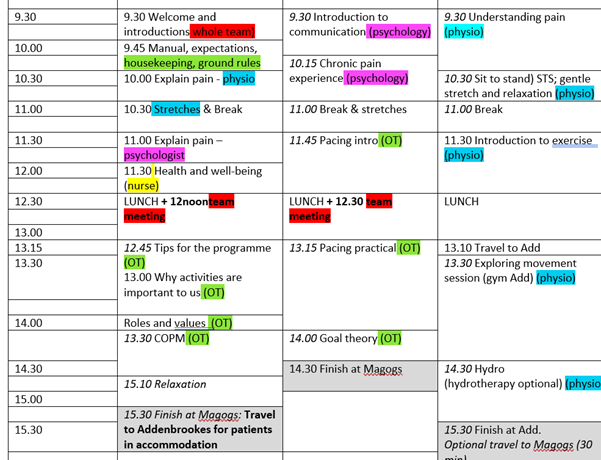
Sessions take place at Magog Court and the physiotherapy department at Addenbrooke’s. Taxis are arranged to take you between Magog Court and Addenbrooke’s.
The programme includes a friends and family day in week two. This is an opportunity to bring a friend or family member along to help them understand more about chronic pain, review how they can support you with your pain management strategies, and address any questions they may have.
What happens next?
At the pain management programme assessment, you will meet with a physiotherapist, clinical psychologist, and occupational therapist. You can expect to be in the pain clinic for up to an hour and a half.
You will be asked questions about your pain problem, physical functioning, psychological coping, and your daily activities. If you are offered a place on the programme, the option of accommodation will be discussed with you if required.
If you are not offered a place on the programme, we will discuss an alternative plan that may include individual therapies. If you do not wish to take part in a programme following assessment, please inform the clinical team as soon as possible.
Benefits
Feedback from previous programme participants include :
- “I feel like I’ve got the old me back”
- “I finally understand what’s going on with my pain”
- “I’m doing more of what I want to do”
- “I know the right kind of exercise”
- “I’m thinking in a more balanced way”
- “I can do the day to day things I need to do around the house”
- “I’ve got a plan for the months ahead”
Risks
There are no known long-term risks to using pain management strategies. Taking part in the programme may lead to a short-term increase in pain and fatigue. This increase can be because your body is getting used to more physical movement as well as the demands of the programme. Sitting in chairs for some of the programme can cause temporary discomfort, but participants are encouraged to stand up and move around. You may also experience some distress during the programme, as some of the things we talk about may be challenging emotionally. You will be supported at all times by the programme team.
Most participants say these changes are short lived and get better over the course of the programme. If you do experience more pain or distress during the programme, it is important that you tell us so we can work together to help you cope.
Alternatives
Alternatives to the pain management programme may include individual clinical psychology, physiotherapy or occupational therapy sessions through the pain clinic. We may also signpost you to other services that may be more appropriate to your needs. We would discuss this with you at assessment.
Privacy & Dignity
We are committed to treating all patients with privacy and dignity. The confidential nature of the group sessions is discussed at the start of the programme. Conversations with staff are confidential unless it is thought that there is a risk to your own or another person’s safety. The department of pain medicine is compliant with Trust policies for patient confidentiality. If you have any concerns at any stage, please speak to a member of staff in pain clinic or to your GP.
Further information contact details:
Should you require further information please contact the Pain Management Programme Administrator, Department of Pain Medicine, Box 215, Addenbrooke’s Hospital, Hills Road, Cambridge, CB2 0QQ. Telephone number 01223 216993.
We are smoke-free
Smoking is not allowed anywhere on the hospital campus. For advice and support in quitting, contact your GP or the free NHS stop smoking helpline on 0800 169 0 169.
Other formats
Help accessing this information in other formats is available. To find out more about the services we provide, please visit our patient information help page (see link below) or telephone 01223 256998. www.cuh.nhs.uk/contact-us/accessible-information/
Contact us
Cambridge University Hospitals
NHS Foundation Trust
Hills Road, Cambridge
CB2 0QQ
Telephone +44 (0)1223 245151
https://www.cuh.nhs.uk/contact-us/contact-enquiries/