
- Part 1- The examination
- Part 2- Preparation instructions
Part 1- CT Colonography examination
Please read all of the leaflet thoroughly before starting your preparation.
This leaflet is for patients who have been referred for a CT Colonography examination.
This procedure is also known as a CT pneumocolon or a CT virtual colonoscopy. This leaflet will explain what the procedure involves and what the risks are.
Every year thousands of people fail to keep their appointments. If you do not turn up, we cannot give your slot to someone else. If you are unable to attend, no longer need the scan or would like to re-arrange your appointment, please call 01223 217426.
What is CT Colonography?
‘CT’ stands for Computed Tomography, which means using x-rays to produce ‘sliced’ pictures through a part of your body, which can be reviewed by the doctor in two and three dimensions.
CT Colonography is a test used to look at your large bowel (colon and rectum). In order to do this a small flexible tube (about the size of a traditional biro) is inserted into your back passage and carbon dioxide gas is gently introduced, to inflate your colon (large bowel). You will be asked to lay on the scanner table which then passes into the scanner which is circular and has a large hole in the middle.

It is open at both ends and often referred to as doughnut shaped. During the scan the table will move in and out the scanner as it takes images and you will be asked to hold your breath. Each scan and breath hold is only a matter of a few seconds.
The purpose of the test is to try and find out what may be causing your symptoms (for example, a change in bowel habit, weight loss, anaemia or rectal bleeding). You will need to prepare your bowel by drinking Plenvu, which is a laxative and Gastromiro, which is a contrast agent. You will also need to follow a strict diet for 24 hours before your scan. It is important you follow the regime to ensure the pictures are good quality.
What happens during the examination?
Firstly, the radiographer will explain the procedure, and answer any questions you have. You may be asked to change into a hospital gown to prevent any metal objects showing up on the pictures. The radiographer will put a cannula into one of your arms.
You will then be asked to lie down on the scanner table on your right side and the small flexible tube will be inserted into your back passage a few centimetres. This will allow the radiographer to slowly introduce some carbon dioxide (CO2) and inflate the bowel which enables the doctors to see the walls of your bowel clearly. This may make you feel bloated and a little uncomfortable but it shouldn’t be painful.
Most patients are given two injections through the cannula. One is called Buscopan (an anti-spasmolytic drug) which reduces the natural movement of the bowel and makes it more comfortable for you. The other is an iodine-based injection to improve scan detail in your abdomen and pelvis. Possible side effects from this injection is a brief warm sensation and a metallic taste. Scans will then be taken whilst you lie in different positions (usually on your right side and your back or your left hand side) to ensure we are able to see all of the bowel.
Please note that we have both male and female radiographers performing these examinations. They will also be accompanied by another radiographer acting as a chaperone during the examination.
If you would prefer a radiographer of the same sex as yourself performing your examination, please contact CT reception prior to your appointment so we can make arrangements to accommodate this.
How long will the examination take?
The whole examination will take about 30-45 minutes. Unless there are delays to the list, your total time in the department should be about one hour.
What should I expect after the examination?
- At the end of the examination the tube will be removed. You may want to visit the bathroom to expel some of the gas although most of it will be absorbed inside or expelled naturally over the course of a couple of hours following the procedure.
- You may experience some abdominal discomfort from the gas, this will ease as it is absorbed or released. You may also experience some residual diarrhoea which is due to the remaining bowel preparation you drank the day before the scan. Please drink plenty of fluids and do not take any medications to counteract this.
- You will be asked to stay in the department for about 15 minutes. You will be offered a hot drink and something to eat (feel free to bring something else with you). After this time we will remove the cannula and check that you are comfortable before you leave the department and at this point you can start to eat and drink as normal.
- If you received Buscopan for your scan, you may have blurred vision following the injection. Your eyesight will however return to normal within an hour.
- Do not drive or operate heavy machinery until your eyesight has returned to normal.
Are there any risks or side effects?
CT Colonography is generally regarded as a safe test. Problems are rare and are similar to those which could happen with other methods of examining the bowel.
These include the following:
- There is a risk of making a small hole to the lining of your bowel wall. This is very rare, less than 1 in 3000 tests and can be seen on the scan.
- There is a risk you may react to either the x-ray dye or the Buscopan. The radiographer will ask you questions to reduce this risk before giving you the injections.
- Very rarely, the injection can cause painful blurred vision in people who are already at risk of glaucoma. If this occurs you should go to your nearest emergency department.
- The bowel preparation, Plenvu, has a strong laxative affect and may cause dehydration or an electrolyte imbalance. It is important that you drink plenty of fluids. In some people it can cause abdominal pain, abdominal fullness, bloating, nausea, thirst, headache, fatigue or anal discomfort.
- The Gastromiro may rarely cause nausea and vomiting, skin rashes and very rarely an allergic type reaction.
- If you are concerned that you may be experiencing any of the above, please do not take any more Plenvu or Gastromiro and contact the CT department on 01223 217426 or your GP.
- Taking the bowel preparation might prevent the absorption of the oral contraceptive pill. Additional contraceptive precautions should be taken until your next period begins.
- As with all x-ray examinations, there is a small risk from the use of radiation. The dose is kept as low as possible and is equivalent to a few years of natural background radiation.
Are there alternative tests?
CT colonography is the alternative test to optical colonoscopy. This involves passing a narrow flexible camera into the back passage into the colon to examine the colon lining. This remains the standard test for the large bowel. It is more invasive than CT Colonography and usually requires sedation. It does, however, allow tissue samples to be taken if needed.
Often CT colonography is used where the optical colonoscopy has not been successfully completed, which can be for a number of reasons.
A colonoscopy can only give information on the inside of the large bowel, whereas CT Colonography also provides extra information on the other structures within your abdomen.
When and how will I get the results of the examination?
The pictures taken of your bowel will be reported by a radiologist (specialist radiology doctor) and a report sent to your referring doctor who will inform you of the results. This report will also be available on MyChart after it is signed by the radiologist.
If you have an appointment booked, the results will be ready by then. If you do not have another outpatient appointment and you do not hear anything within three weeks, please contact the department that referred you for the scan.
Part 2 - How to prepare for your scan CT Colonography?
What do I have to do before my appointment?
It is very important that you have a well prepared bowel so that we can take good quality images.
To do this we will ask you to:
- Take a laxative called Plenvu. You should experience diarrhoea and may feel stomach cramps with it, this is normal.
- Drink 1 dose of a contrast agent called Gastromiro. This contains Iodine and acts as a dye on the inside of your bowels.
- Follow a special low residue diet the day before your test (as per the below flow chart).
If you have concerns about your suitability for the procedure due to limited mobility when taking the bowel preparations, please give the CT Department a ring on 01223 217426.
During this time you will need to:
- Stay near a toilet at all times.
- It is ESSENTIAL that you drink plenty of fluids to prevent dehydration.
- Use extra precautions if you take the oral contraceptive.
If you have a stoma please bring a spare flange/baseplate and stoma bag with you to your CT appointment.
Can I take other medication along with the bowel preparations?
- If you are taking iron tablets please stop them for 7 days prior to your scan.
- If you are taking NSAIDs (non-steroidal anti-inflammatory drugs) please stop taking them the day before and resume taking them 3 days after your test.
- If you are taking any weight loss medication please stop them for 7 days prior to your scan and resume them when you have returned to normal eating.
- Please DO NOT take Buscopan the day of your examination.
If you are diabetic please read the chart on page 6 as the diet may upset your diabetes.
If you are taking beta-blockers, hypersensitivity or allergic-type reactions may be aggravated. Please contact the CT department on 01223 217426 if this happens.
You should continue with all other regular medication as prescribed by your doctor unless directed otherwise.
Is there a reason why I should not take the bowel preparations?
Please do not take the Plenvu and contact the CT department on the telephone number for further information if you believe you have any of the following:
- Hypersensitivity or allergy to Plenvu or Gastromiro or to any of the following: iopamidol; sodium picosulphate; sodium sulphate; macrogol; sucralose (E955); aspartame (E951); glycerol (E422), gum acacia (E414); maltodextrin (E1400); ascorbic acid; sodium ascorbate; sodium cyclamate; disodium edetate dihydrate; sodium saccharinate; citric acid
- Patients < 18 years of age
- Bowel obstruction
- Bowel perforation
- Paralytic ileus
- Patients with disorders of gastric emptying (e.g. gastroparesis)
- Phenylketonuria
- Glucose-6-phosphate dehydrogenase deficiency
- Toxic megacolon
- Severe acute inflammatory bowel disease such as ulcerative colitis or Crohn’s
- Toxic megacolon
- High or low sodium or potassium
- Significant renal impairment
- Severe heart failure
- Acute appendicitis
- Severe dehydration
- Pregnant
- If you have a brain condition such as a tumour or epilepsy as it may induce seizures
- Alcoholism or recreational drug use as they may induce seizures
- Asthma
If you are hypersensitive to iodine-containing contrast media or have hyperthyroidism then you should not take the Gastromiro. Please contact the CT department on 01223 217426 for further advice.
How do I take my bowel preparation?
The preparation for the scan is over a 24 hour period. Please start the diet and preparation the day before your appointment.
***Please note; DO NOT open the Gastromiro until you need to drink it as directed in the flow chart below.***
(Do NOT stop taking your normal medication except those detailed in the instructions above)
DAY BEFORE the examination:
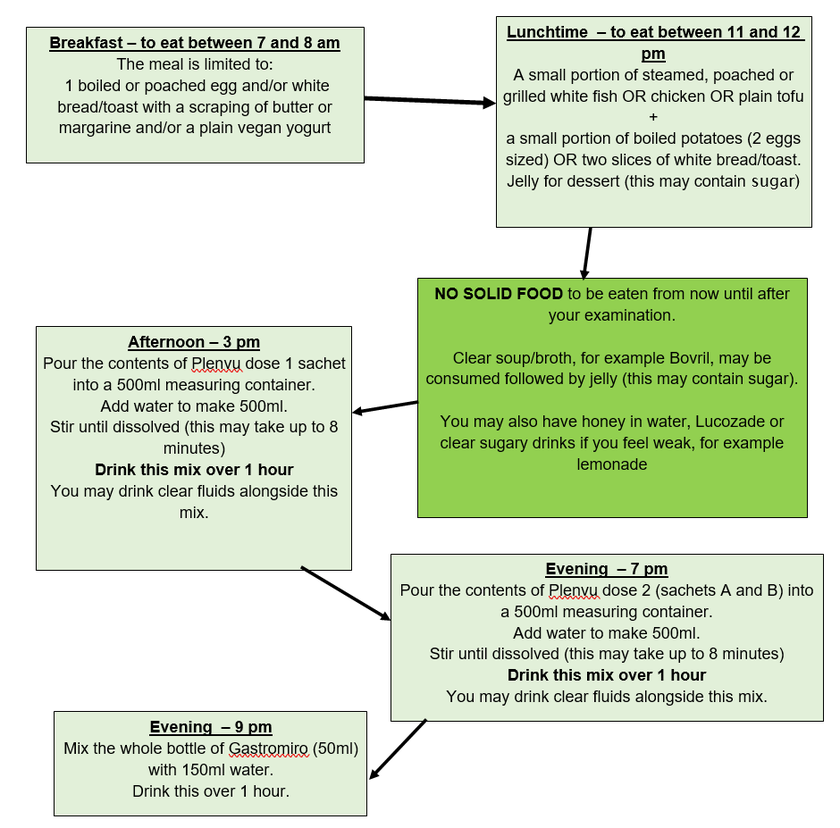
Breakfast – to eat between 7 and 8 am
The meal is limited to:
- 1 boiled or poached egg and/or white bread/toast with a scraping of butter or margarine and/or a plain vegan yogurt.
Lunchtime – to eat between 11 and 12 pm
- A small portion of steamed, poached or grilled white fish OR chicken OR plain tofu + a small portion of boiled potatoes (2 eggs sized) OR two slices of white bread/toast.
- Jelly for dessert (this may contain sugar)
NO SOLID FOOD to be eaten from now until after your examination.
Clear soup/broth, for example Bovril, may be consumed followed by jelly (this may contain sugar).
You may also have honey in water, Lucozade or clear sugary drinks if you feel weak, for example lemonade.
Afternoon – 3 pm
- Pour the contents of Plenvu dose 1 sachet into a 500ml measuring container.
- Add water to make 500ml.
- Stir until dissolved (this may take up to 8 minutes).
- Drink this mix over 1 hour
- You may drink clear fluids alongside this mix.
Evening – 7 pm
- Pour the contents of Plenvu dose 2 (sachets A and B) into a 500ml measuring container.
- Add water to make 500ml.
- Stir until dissolved (this may take up to 8 minutes).
- Drink this mix over 1 hour
- You may drink clear fluids alongside this mix.
Evening – 9 pm
- Mix the whole bottle of Gastromiro (50ml) with 150ml water.
- Drink this over 1 hour.
Key points:
- Plenvu is a very effective laxative. Be prepared for bowel movements approximately 1 hour after drinking the 1st sachet and throughout the day.
- You may feel bloated and/or mild stomach cramps before your 1st bowel movement.
- Plenvu will cause diarrhoea. A small amount of petroleum jelly or substitute applied to your back passage will help to ease any soreness that may occur.
PLEASE NOTE:
Drink as much clear liquid as possible.
Tea and coffee WITHOUT milk are permitted.
Alcohol is NOT permitted.
THIS DIET IS IMPORTANT AS MILK AND FOODS ABSENT FROM THIS LIST CAN IMPAIR THE DIAGNOSTIC QUALITY OF YOUR SCAN IF CONSUMED.
Because food intake is limited you may require the occasional sugary drink.
DAY OF the examination:
- No solid food until after the examination.
- If diabetic, do not take your diabetes medication until after the examination.
Advice for diabetic patients undergoing CT Colonography
Please follow these instructions if your procedure is in the morning (before 13:00). For any diabetes related questions during bowel preparation, please contact your GP or the diabetes specialist nurses on 01223 348790.
Food and drink
- You must follow the low residue diet the day before the CT colonography.
- On the day of the examination you must NOT eat anything.
- You should drink as much clear fluid as possible, at least a glass every hour to prevent dehydration.
- Make sure you have some sugary drinks available, for example Lucozade (100 mls) or apple/orange juice (200 mls) (NO PULP). Drink these if your blood sugar falls below 4.
- Ensure that your bedtime blood sugar is at least 10.
- Test your blood sugar regularly throughout the day.
Insulin – taken once daily
- No change
Insulin – taken twice daily
- Day before the examination – normal doses
- Day of procedure – do NOT take morning insulin. Bring it with you and take ½ dose with food after the examination
Insulin – taken four times a day
- Day before the procedure – normal doses
- Day of procedure – Do NOT take morning insulin. After the examination take normal short acting insulin with food. Take normal evening and bedtime doses.
Tablets for diabetes
Day before examination – normal doses
Day of procedure – Do NOT take your morning dose. Restart at the next normal dose after the examination unless directed by your radiographer.
Please contact your diabetic nurse for further advice.
- If you are or think you might be pregnant, please contact the CT department on 01223 217426 before taking the medication.
- Email us
- Direct line to CT Scanning reception: 01223 217426
Please contact the CT department between 08:00 – 17:00 (Monday to Friday) as soon as possible if:
- you cannot attend for your appointment for any reason
- you are or there is any chance you may be pregnant
- you weigh more than 180kgs or 28 stone
- you are claustrophobic
- you have limited mobility
Every year thousands of people fail to keep their appointments. If you do not turn up, we cannot give your slot to someone else. If you are unable to attend, no longer need the scan or would like to re-arrange your appointment, please call 01223 217426.
For further information
Please contact the CT department on 01223 217426 between the hours of 08:00 – 17:00.
How to find us
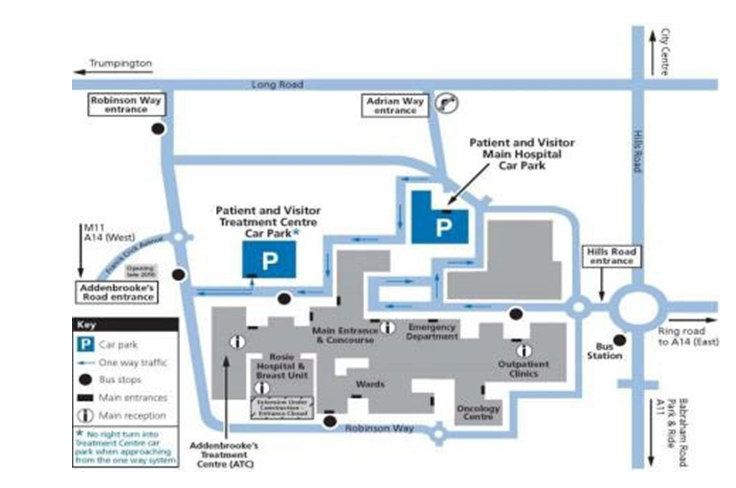
Your CT colon examination is carried out on our CT scanner that is situated within the PET-CT department. This is located between the outpatients and oncology departments on the ground floor. Parking at CUH is limited. Please use public transport if possible. If you do need to bring your car then we have two patient and visitor car parks.
We are smoke-free
Smoking is not allowed anywhere on the hospital campus. For advice and support in quitting, contact your GP or the free NHS stop smoking helpline on 0800 169 0 169.
Other formats
Help accessing this information in other formats is available. To find out more about the services we provide, please visit our patient information help page (see link below) or telephone 01223 256998. www.cuh.nhs.uk/contact-us/accessible-information/
Contact us
Cambridge University Hospitals
NHS Foundation Trust
Hills Road, Cambridge
CB2 0QQ
Telephone +44 (0)1223 245151
https://www.cuh.nhs.uk/contact-us/contact-enquiries/