Pathology teams at Cambridge University Hospitals NHS Foundation Trust (CUH), took home five awards including the overall Biomedical Science Champion award at this year’s Institute of Biomedical Science (IBMS) Awards.
Congratulation to the all the winners. These awards are well-deserved recognition of the outstanding service provided by our teams and the vital role they play in the care of patients both here in Cambridge and across the wider region.
Dr Lizz Grimwade, Lead Healthcare Scientist at CUH
Four of the awards went to our histopathology teams. Histopathology, the study of tissues and cells, is vital in diagnosing and enabling faster treatment for patients with serious diseases including cancer. Our histopathology lab receives more than 80,000 tissue samples each year and provides local, national and international services.
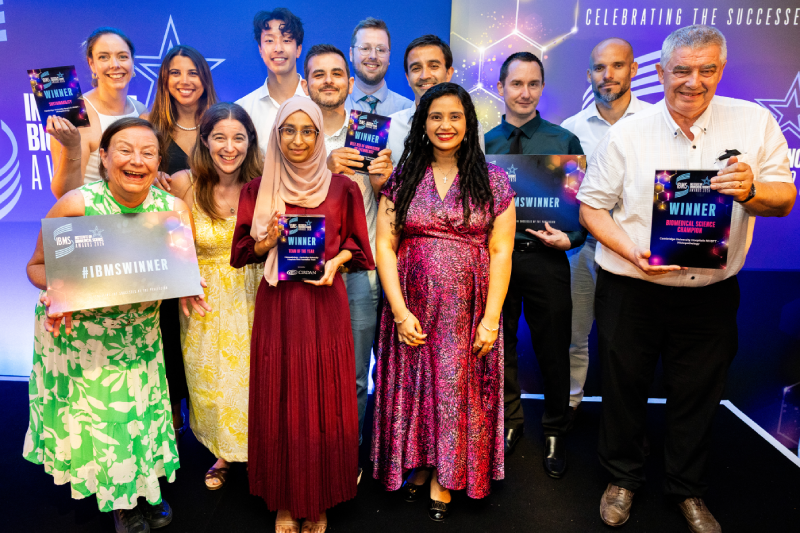
The successes follow the relocation of the lab, which employs more than 200 people, into a new facility on the Cambridge Biomedical Campus, creating a fit-for-the-future service using the latest technologies, automation and placing an increased emphasis on sustainability.
The overall Biomedical Science Champion and Best Use of Innovation or Technology awards recognised how the team is making use of an innovative device, a short-wave infra-red imaging system, to improve cancer treatment.
After cancer surgery, histopathologists study the removed tissue. This involves finding structures called lymph nodes which can be used to understand whether the cancer has spread and whether further treatments such as chemotherapy or radiotherapy are needed.
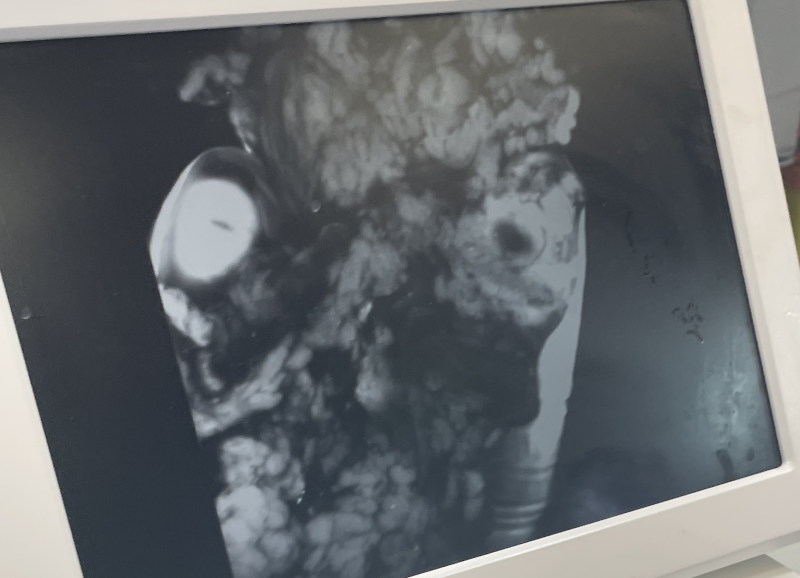
The team in Cambridge are using a tool that makes it easier to find lymph nodes in tissue samples collected during surgery. The technology, which uses infrared light, improves the speed and accuracy of results, giving patients greater certainty about the spread of their cancer and success of treatment. Funding for the technology was made available through Addenbrooke’s Charitable Trust (opens in a new tab).
The judges said: “This technology has proven a significant, positive impact on prognostic accuracy. Therefore, it has clearly improved practice, enhanced patient care and led to favourable patient outcomes.”
The award was jointly collected by Refaie Rassool and James Neal, advanced practitioners in histopathology at CUH.
I’m delighted to win these awards and grateful to Addenbrooke’s Charitable Trust for supporting us to bring this innovation to patients. With this technology we can find and analyse more lymph nodes after cancer surgery allowing us to more accurately assess cancer spread to inform further treatment. This means greater certainty and better outcomes for our patients.
Refaie Rassool, advanced practitioners in histopathology at CUH
The Team of the Year and Sustainability awards recognise success across the team in moving rapidly and effectively into the new facility and working collaboratively with engineers and suppliers to reduce waste, water use and carbon emissions.
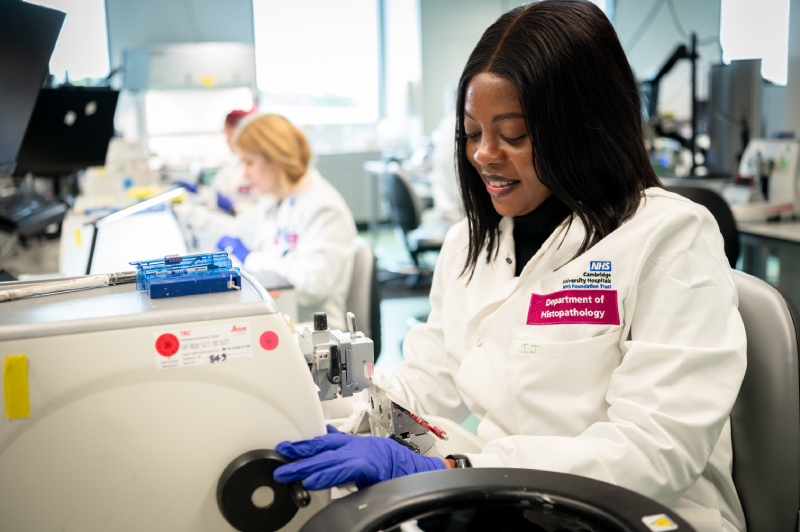
Judges praised the approach the team used to improve lab efficiency, and the ‘immediate, tangible environmental, safety and operational impact’ of the changes made by the team.
Members of the histopathology and genetics labs also recently won the Royal College of Pathologists sustainability award. Find out more.
I’m enormously proud of the whole team. It’s hard to understate their achievements over the last year. Consolidating our laboratories into one new location, delivering new processes and ways of working, all while continuing to deliver a crucial clinical service, has been a huge challenge.
We now have a facility that is ready to support the growing needs of our patients, and that will support new developments in the region, including the future Cambridge Children’s and Cancer Research Hospitals.
Dr Michael Eden, histopathology clinical lead at CUH
The final award, Biomedical Science Leader, was presented to Rhys Tassell, service lead for point of care testing (POCT) at CUH, for his role in delivering ‘near patient’ testing. These tests are used by non-laboratory staff to provide faster results for patients.
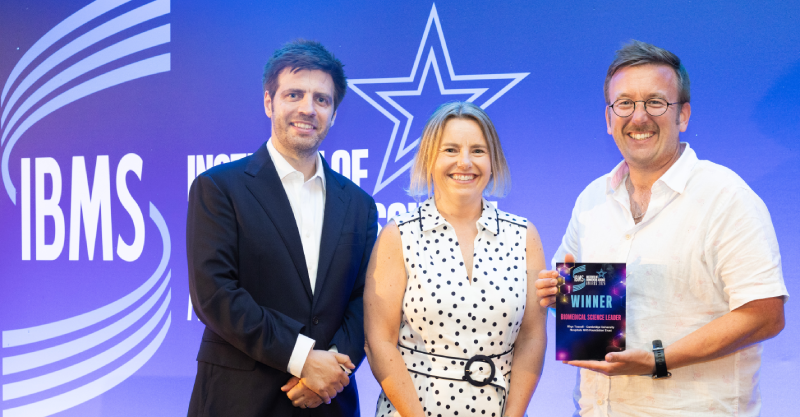
Rhys has particularly helped to deliver viscoelastography testing (VET) in our maternity unit at the Rosie Hospital. The test allows rapid assessment of blood clotting, which can help teams quickly detect and manage major bleeds after childbirth.
Judges said: “Rhys delivered a complex, model POCT service that follows national and IBMS guidance to provide an outstanding patient-centred service. A truly exemplary Biomedical Science Leader.”
Find out more about the awards and Rhys's win (opens in a new tab)
It’s an honour to receive this award. Point of care tests can provide clinicians with near-instant results for their patients, avoiding the anxiety of waiting for results and helping teams to take immediate action, which can make all the difference in critical situations, improving outcomes and overall patient experience.
Rhys Tassell, service lead for point of care testing at CUH
Visit the Institute of Biomedical Science website for full details of all 13 of this year’s awards.